
Social Factor round-up
Asset manager backed think tank vs right to strike, Passions and Interests, voting rights fragmentation, exec pay rises, listed or listing?

Asset manager backed think tank vs right to strike
This is something I picked up whilst looking at a few German asset managers. I’d never heard of Flossbach von Storch before, nor had I come across the Flossbach von Storch Research Institute.
The latter describes itself as follows: “The Flossbach von Storch Research Institute was founded by Flossbach von Storch SE as a think tank committed to free analysis. The Institute positions itself in the gap between sales-related, commercial research and purely academic research.”
It published a paper a couple of years back titled Right to strike, power and competition. The abstract is below:
When do employee and employer cartels prevent welfare-enhancing market solutions? Which actions are incompatible with the protection of the individual freedom of all citizens? When should the right to strike be restricted?
And here’s the argument in a nutshell:
As long as there is competition between providers, consumers can take evasive action if strikes threaten their supply. It is annoying for Lufthansa customers if they are unable to take their flight due to a cabin crew strike. However, in future they will be able to book their flights with other providers who are more reliable. Under competitive conditions, the abuse of power by strike-happy unions is therefore severely restricted. If they behave irresponsibly, the company ends up going bankrupt and the employees lose their jobs.
The situation is different in state-owned or state-affiliated monopoly companies such as Deutsche Bahn. There, a sectoral union such as the train drivers' union can paralyse an entire company without any risk to its members' jobs - and thus large parts of the economy if this company has a network function. In such companies, the right to strike should be restricted by law. It is conceivable that employees of such companies - like civil servants in the German state - should not be granted the right to strike at all. Anyone who objects to this does not have to become a civil servant - or a train driver.
I know lots of people in finance are not exactly pro-union, but I don’t recall ever before seeing an organisation put out a paper arguing for the removal of the right to strike.1 Obviously this argument is restricted to state monopolies but it’s still quite an extreme position,
For completeness, Flossbach von Storch (the asset manager) does have a position in Deutsche Post which still has the dominant share of domestic postal deliveries, if no longer a legal monopoly.
Passions and Interests
Interested to see this piece being trailed on The Economist.
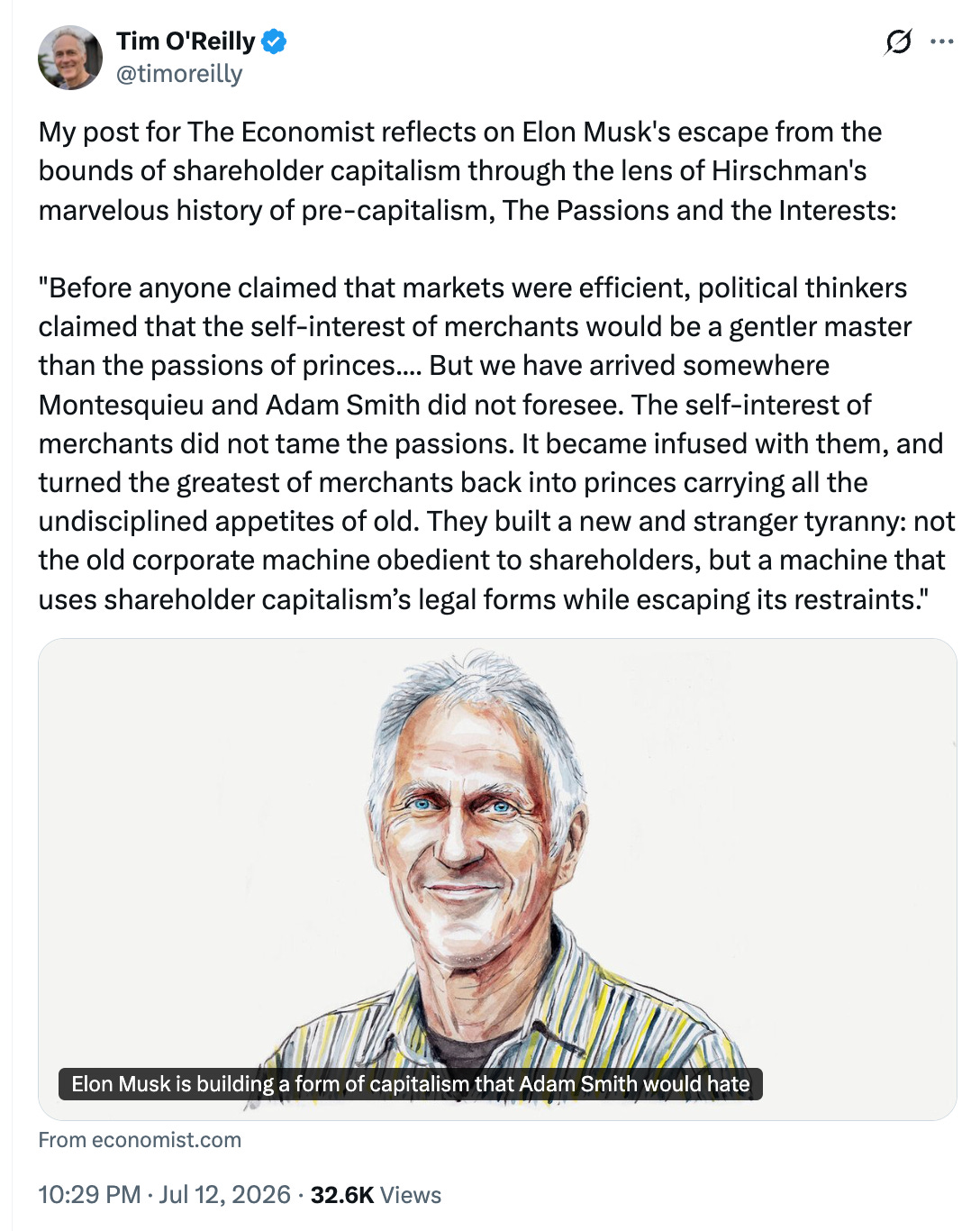
I’m a big fan of Hirschman and The Passions and The Interests is a great book. The title refers to an argument made by proponents of capitalism that allowing princes to have and indulge (financial) ‘interests’ would give them an alternative outlet to, or even distraction from, their (political) passions, which otherwise might lead to war. (NB. It’s not Hirschman’s argument.)
I had a very similar thought last year about how Elon Musk seems to challenge this very long-standing piece of wisdom:
Arguably Elon Musk provides the best falsification of it. Having amassed enormous wealth he is now using this to exercise political power, including interfering in the politics of other countries, amplifying the Far Right, seeking to shape the media landscape and so on. Contrary to the original claim, his interests have enabled him to indulge his passions.
Perhaps we need to make an exception because Musk is so rich. Perhaps there are only a handful of people who can act in this way. But the argument, crudely put, that letting people make a lot of money will distract them from things that are more damaging to society looks pretty dead.
Since then Musk has obviously ended his direct involvement in the US administration, but he remains deeply involved in politics and many things that his companies are involved in have obvious political ramifications (just look at the discussion of the use of Starlink). And now he’s got his eyes on space. It all looks pretty passionate doesn’t it?
Perhaps we should also see the big tech firms as a fairly unique type of corporate form in our era. These firms have grown up, and built power, without a sense of accountability. There is no history of countervailing power (labour, consumer, investor, whatever) and they have deliberately weak minority shareholder rights. There is seemingly nothing inherent in their history or culture that might have created a sense that there are other interests in the firm that have legitimate views that need to be balanced. It’s perhaps not surprising that they act the way they do.
Voting rights fragmentation
A few months back I spent a lot of time looking at voting rights disclosures and whether this provided an insight into the scale of pass through voting. I’m still unclear if it is indeed PTV that explains some of the disclosures, but I thought it was worth a quick snapshot.
SEGRO is currently the subject of a takeover bid by US firm Prologis. As a result there are a bunch of Rule 8.3 filings being spat out by market participants. Looking at BlackRock’s filings, it discloses that it does not have voting authority for over 1% of the issued shares in both the target and the acquirer.
Here’s a SEGRO disclosure:
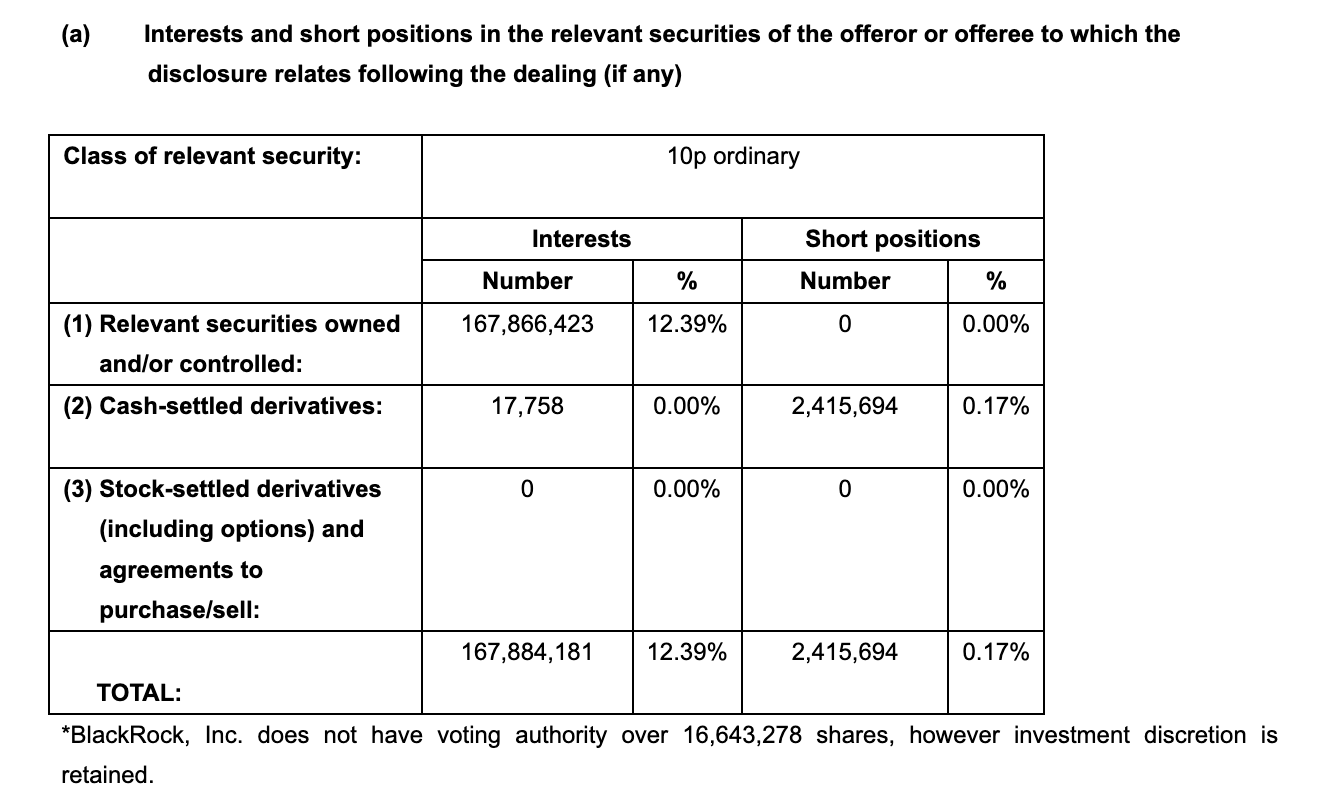
It holds 12.39% of the shares (167.9m), but its disclosure shows it does not have voting authority for 16.6m shares, which I make about 1.22% of the ISC. So that’s about 10% of its position where it doesn’t control the votes.
And here’s a Prologis filing:
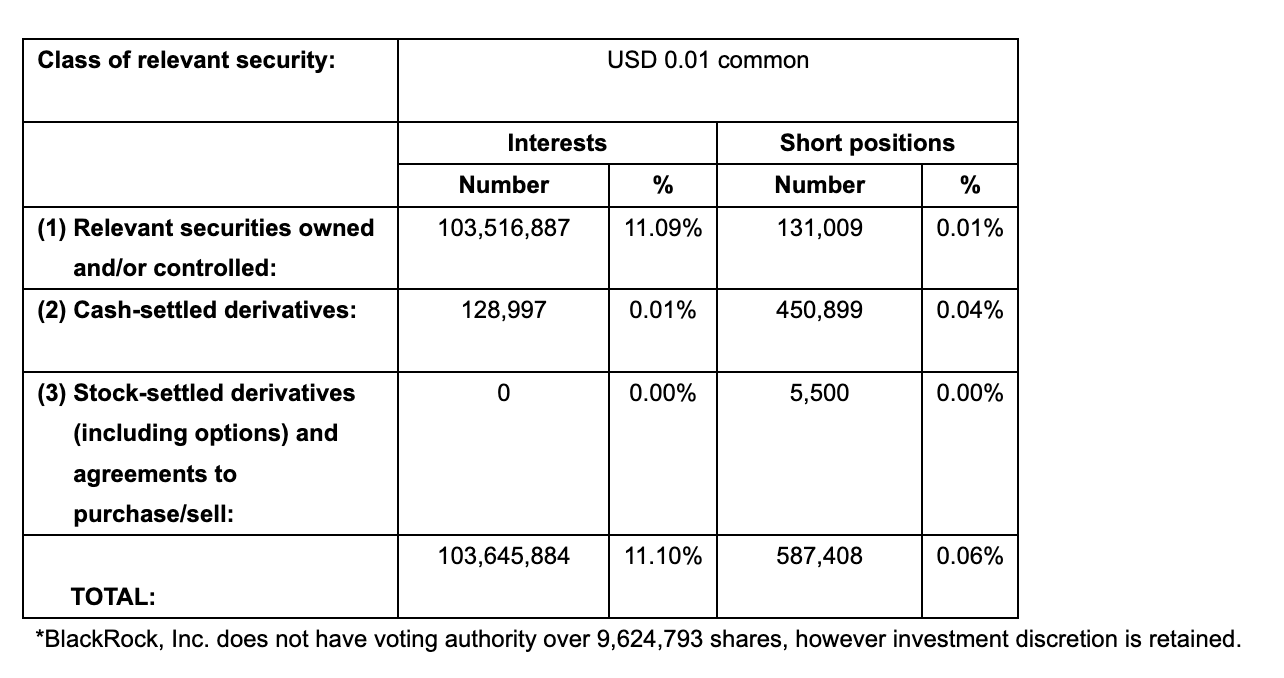
11.09% of the shares, or 103.5m in number. But no voting discretion for 9.6m shares which I make just over 1% of the ISC. So that’s 9% of its position where it doesn’t control the votes.
I don’t know Prologis but it’s a large cap stock in the S&P 500 and SEGRO is in the FTSE100 and BlackRock is the top shareholder in both companies. So it feels pretty significant that it does not vote a sizeable chunk of its position in both companies.
PS. This is also another case where different filings don’t show the same position. Here is a recent TR1 released in relation to BlackRock’s position in SEGRO, showing it as dipping just under 10% of the ISC. Go figure.
Exec pay pay increases
Some analysis of FTSE100 pay from the High Pay Centre:
Our latest annual CEO pay report has found that the pay of the CEOs of Britain’s biggest companies increased by 8.6% in the 2025/26 financial year.
Median pay for a FTSE 100 CEO increased from £4.66m in 2024/25 to £5.06m in 2025/26. This is the highest level of FTSE 100 CEO pay on record, and the fourth successive year that CEO pay has grown. The last four years have all been record breaking.
Mean FTSE 100 pay dropped from £6.09 million to 5.89 million. However, this decrease can mostly be attributed to an exceptionally high pay award for Melrose Industries of £58.93m. If Melrose is excluded from last year and this year’s samples, mean pay would have increased by 6.5% from £5.53m to £5.89m
The research shows that the median FTSE 100 CEO is now paid 130 times the median UK full time worker, up from 124:1 in 2024/25.
The median is possibly the most revealing figure here, CEO pay has now reached a record for four successive years. There has been much discussion in the business pages in recent years of the need to allow UK PLCs to compete for talent, particularly with US firms. This might be what it looks like in practice.
Listed or listing?
According to the FT, the government has been talking to private equity firms to ask them why they don’t list their portfolio companies in the UK.
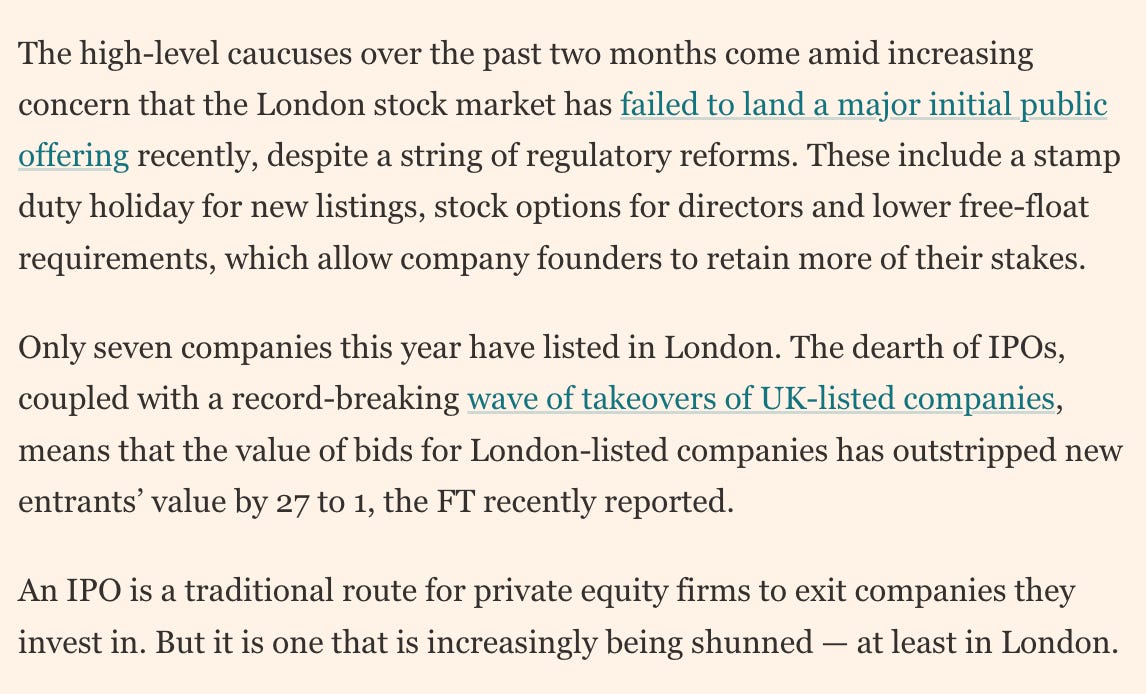
This is all well and good, but the question is whether we are concerned about the number of companies listing in the UK or being listed here. While IPOs increase the total number that are listed, takeovers obviously reduce it.
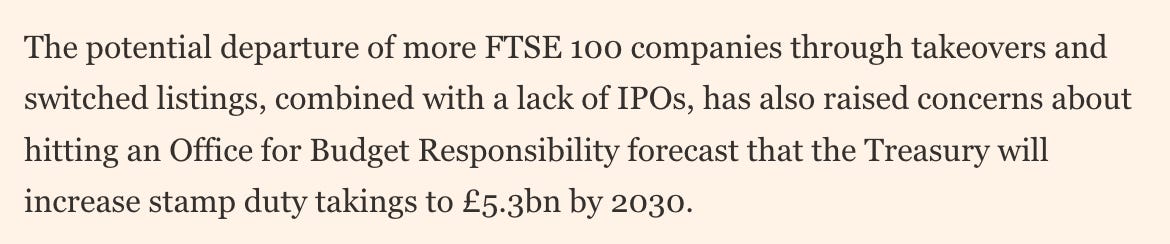
Private equity firms are amongst those whose activity takes companies off the UK market. So if you only look at entry (listing rules etc) and not exit (the takeover regime) you’re not really tackling the number of companies that are listed here.
Of course, if your interest is in transaction volume (so entry plus exits) you might look at it slightly differently. I think that is where City really has its focus, hence no talk about about the takeover regime. Is that the government’s views too and does the political leadership get the difference between the two positions?
Populism webinar - Wednesday 29th July
Just a reminder that I have a lunchtime webinar coming up on Wednesday 29th July on Populism and Responsible Investment in the UK.
Here’s the registration link:
https://us06web.zoom.us/webinar/register/WN_1wzG6m9eQnqY-xyhlGEwMA
Though the private equity trade body the BVCA - now UK Private Capital - did support the introduction of employment tribunal fees. The introduction of fees was later successfully challenged by UNISON on the grounds that they prevented access to justice and were discriminatory. The Supreme Court agreed.