
Reform UK rolls on

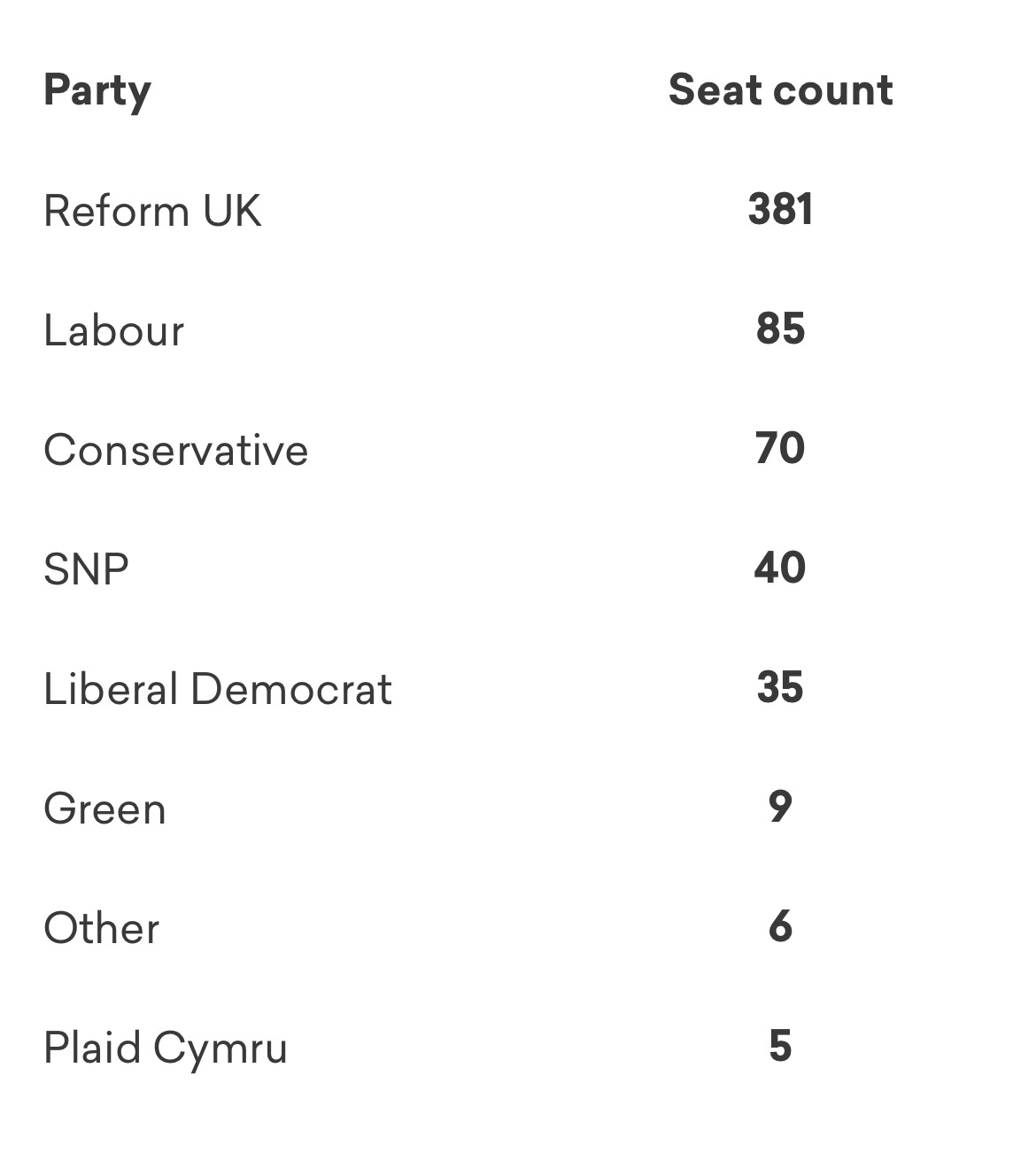
A New Year, but the same political trajectory. A new MRP poll from More In Common shows that on current polling Reform UK would win a majority at a general election, with no other party getting to triple figures in terms of seats.
This should also be an important wake-up to those who might be thinking that Labour’s implosion might not be entirely bad if a broader coalition of the Centre and Left emerges. Under this poll Labour loses over 300 (!) seats, but the Lib Dems also lose half of theirs. The Greens don’t even make it to double figures.1 No-one is riding to the rescue I’m afraid.
The collapse of the Big Two parties under this model is really something.
A few obvious points:
It’s just one poll (though not out of line from other MRPs) and lots of things could happen in the next three years.
There are a lot of tight results in this poll - Reform UK wins over 100 seats on less than a third of the vote. Some of these could easily tip out differently, pointing to a hung parliament.
That also means tactical voting / ‘who do I hate the least out of the viable candidates’ becomes a big factor.
If Labour gets desperate does voting reform (PR) suddenly come back into vogue? I’m not sure they can do anything in time and it would be attacked as ‘anything to stop Reform’. But come May I suspect this argument will reappear.
That said a couple of these points work both ways. As much as there are many voters who will be motivated by ‘anyone but Farage’ there are also many who will be thinking ‘what’s the best way to get Labour or a Labour-led coalition out of power?’ Reform UK voters in particular hate Labour and are the most likely to say they will never vote for the party they dislike.
Put simply, there is scope for tactical voting on the Right that personally I have previously under-appreciated. There’s a good piece on anti-Labour tactical voting here that made me think again. I’ve tended to think Reform UK has a vote ceiling of around 30%. But while this is true in opinion polls it may not be so in an actual election and specifically at individual seat level.
I think the reality of what is coming is even now not really internalised by a lot of people. That’s not surprising since ‘a high probability of something bad happening’ is always more abstract than ‘something bad just happened’ but it does mean we should expect a lot of volatility in May.
As things currently stand Labour is going to do very badly. I think Wales is going to be particularly brutal and the Caerphilly by-election is possibly a sign of how it will play out - the Right vote coalesces around Reform, the Left around Plaid Cymru. I can envisage Labour in Wales ending up in the low teens as a vote share, perhaps lower.
This is important because Labour’s position as the most electorally viable party on the Left took decades to build and has been a bit of mental scaffolding for many voters for many elections. Once it’s gone it’s gone. Looking at Scotland, since the SNP displaced Labour its parliamentary representation has been very volatile but Labour has clearly not re-established the default/tribal voter support it used to enjoy. That is coming to Wales next.
This is all for political context. My interest is primarily in how this shapes policy, particularly in the areas I work in. I’ll dig into this more in future, but a couple of things to note:
Reform UK voters are more Trump-friendly than even populist/radical Right voters in France and Germany.
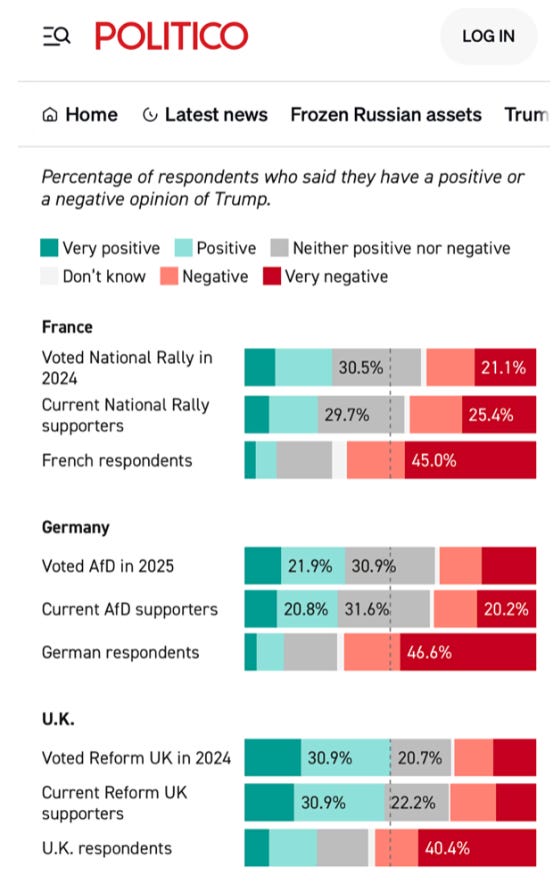
As a practical outcome, they are likely to be more more sympathetic to Trump’s actions in Venezuela. This may tell us something about potential foreign policy positioning under a hypothetical Farage-led government.

I think it’s quite possible that Reform UK supporters are more aligned with the DOGE agenda in the US too, though it will be dawning on its growing number of councillors just how much money there really is to be saved in, say, scrapping DEI initiatives. But the challenges a Reform UK government itself would face (and that its representatives in local government will be starting to realise) is a question for another day.
Also, I found this story that appeared in City AM just before Christmas, floating the idea of a Reform UK government taking a stake in Rolls Royce, very interesting. I think it’s just kite-flying but again it apes the US government’s position on strategic stakes.
I’ve refined my thinking about what direction Reform UK will go in economically. I had thought they might strike some left-ish poses to try to cause Labour some problems. But the one big lesson I take from Labour’s ‘strategy’ is that boosting the salience of an issue (immigration in that case) where your opponent is strong and where their voters hate you is disastrous. So I wouldn’t expect / place much meaning on anything where they suggest a redistributive agenda - that is likely throwaway left-sounding stuff for headlines.
To the extent there is some genuine policy behind the headlines perhaps the Rolls Royce example might be more the shape of things (I don’t suggest this particular policy is the finished article). Using the power of the state in relation to security (physical, energy etc) - or at least framing it that way - could be where Reform has an edge. In contrast they are unlikely to be nationalising anything, even in part, because of concerns about investors making too much relative to workers or customers.
Bottom line: a Reform UK government is becoming electorally plausible, a number of current assumptions in policy, regulation - including in my world of corpgov, stewardship and responsible investment - are likely to be off-base, and not in the ways you might expect.
Just for a bit more cold water to the face, when I looked at total councillors for the various parties for my webinar on populism and RI at the end of September the Greens had more than Reform UK. Since then the picture has reversed. Reform UK is winning more local elections than any other party (and Labour is losing more).