
Woke chicken: a common problem
A drop off in support for ESG resolutions only confirms the power of the big passive managers.

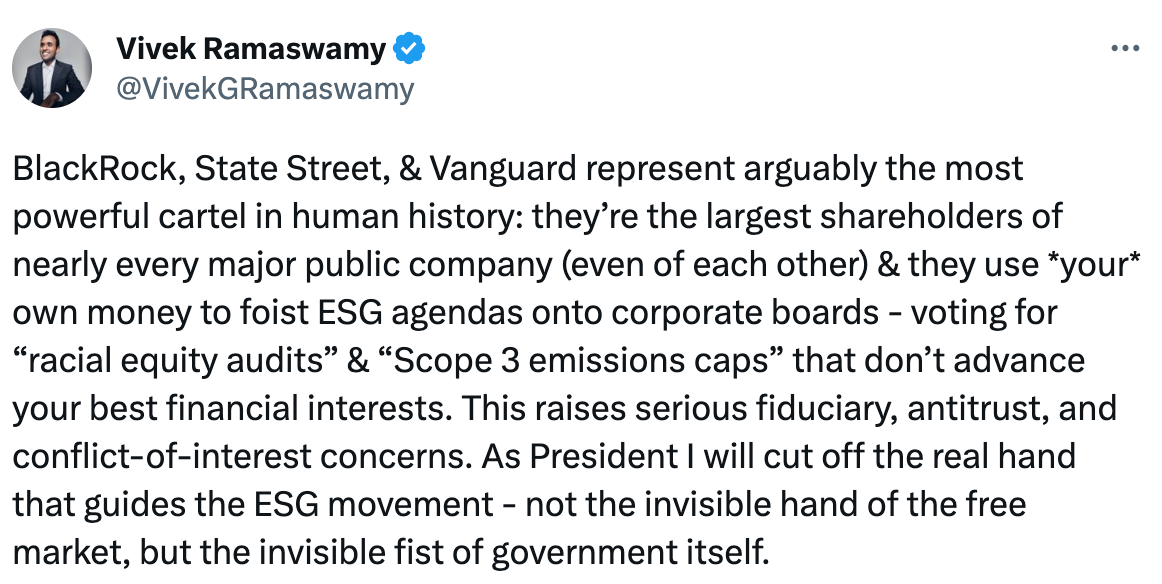
Vivek Ramaswamy might be an outsider in the GOP presidential candidate race, but his recent attack on the major US managers over their support for “ESG agendas” is notable. For me, not so much the focus on ESG - which has been a target for Right-of-centre politicians in the US for a couple of years now - but the language related to competition. “The most powerful cartel in human history” is not something any asset manager wants to be associated with, but it does highlight a challenge that looks likely to continue to dog the passive mega managers.
Interestingly Ramaswamy’s attack on the Big Three came just a couple of weeks before voting data disclosed by both BlackRock and Vanguard showed a sharp drop in the managers’ support for ESG-oriented shareholder proposals. This won’t be news to many people who work in Responsible Investment or related fields, as support had already been dipping in the face of the anti-ESG backlash. Perhaps the only surprise was that Vanguard’s support has fallen even lower than it was.
As an aside, I think anyone who is involved in the practice of filing and getting the vote out for shareholder proposals should at least listen to the reasons the managers have given for lower support. The claim that some proposals are too prescriptive is not new, but if it is a factor that some of the managers will use in deciding whether to support it needs to be part of the planning process, regardless of what you might think of the claim. There might be half a point too in the related claim sometimes made that in the growing number of ESG proposals some are not as well crafted as they might be.
That said, the point I want to address in this post is the concentrated power that Ramaswamy and others now regularly attack. This is directly related to the drop in support for ESG proposals and is a serious issue that deserves some clear-headed analysis.
For there to have been such an apparently sharp change in the approach to ESG proposals raises a number of questions. Does it mean that the position previously adopted by some managers had been superficial? Were previous votes cast for ESG proposals driven to some degree by how they would be viewed externally rather than simply by how they would affect the company at which they had been filed?
Passive managers are in a different position to their active counterparts in that their relationship with clients does not rely on investment performance. One of the principal ways to boost revenues is to grow assets under management, and marketing and client relations are critical competencies. One could imagine that, in recent years, adopting a position of voting for many ESG proposals would have been advantageous, and a position of voting against them would have been a problem. Indeed campaigners have sought to target the relationship between asset managers and their clients as a way to push them to support various ESG initiatives. A focus on voting records has been one route to this.
What has changed is that the group of campaigners using this tactic has expanded to include US Republicans. A focus on votes on shareholder proposals is a pretty basic metric that can be used to assess managers (I’ve done it myself plenty of times). It can also be read very differently depending on your perspective. Ramaswamy’s tweet obviously defines support for ESG initiatives as a problem. Racial equity audits, for example, had been a highly successful type of shareholder proposal. Now that critical scrutiny of voting for ESG proposals has emerged this has presumably changed the calculation for some asset managers about the relative value of positioning a particular way when voting on them. More broadly there is also evidence of managers rewriting or removing ESG-related content from websites and documents, and some discussion of dropping the ESG label altogether.
My sense is that this is primarily a business decision. No doubt there have always been internal critics within the Big Three of the embrace of ESG issues. But ultimately these organisations are trying to make money through services related to asset management (I use a vague term here because of the significance of stock-lending, for example). Therefore orientation towards ESG issues is shaped by how it makes it easier or harder to meet that overall objective. I do not think it is ideologically driven, even though it matters politically. The point to focus on is that the position of major financial institutions can change significantly and quickly.
Looking at shareholder proposals specifically, perhaps they don’t matter a lot, to the companies where they are filed, compared to the other challenges issuers face. But they do matter a bit, as evidenced by the effort some companies will expend on fighting them. Therefore significant changes in orientation by those who both invest in everything and cast a large number of votes matter a bit to a lot of companies. Overall, surely that matters a lot. It is something that any decent board member or investor relations professional is going to be alert to. I also think it’s not overstating it to say that the overall significance might be akin to a (de)regulatory change.
What is ironic about this development is that it underscores the growing power concentrated in a small number of financial institutions. Even as the needle moves more in Ramaswamy’s direction, as some managers reduce support for ESG proposals, it does prove he has half a point. Whichever way the Big Three point it matters.
This is why the allusion to cartel-like behaviour and the mention of antitrust may matter more in the long term than votes on ESG proposals. That concentrated ownership is still there even if the votes are cast a different way. It seems that the big US passive managers have been particularly concerned by the Common Ownership critique which suggests that they may be implicated, even through inaction, in creating an anticompetitive environment.
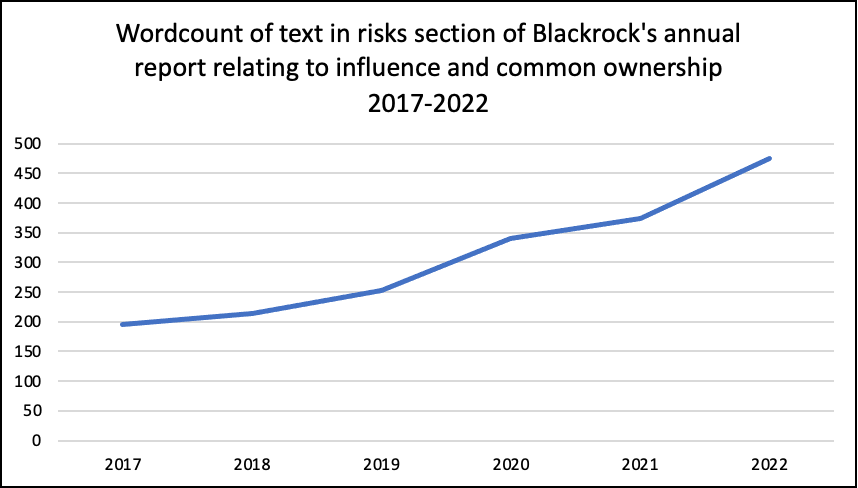
BlackRock has been disclosing concerns about Common Ownership in its annual reports since 2017 and has a section on its website devoted to refuting the critique. The website doesn’t appear to have been updated recently and perhaps seeking to disprove the issue increases its salience. The commentary in its annual reports, however, has grown in length and depth. The 2017 version highlights the issue in general terms, whereas in 2022 the text refers to Common Ownership becoming part of the thinking of competition regulators and related bodies.
As to the substance of the criticisms made of the large passive managers, this is from BlackRock’s 2022 disclosure:
Some commentators have argued that continued growth of index funds has the potential to impact stock market competitiveness by exacerbating stock price moves and market volatility. Some commentators, regulators and lawmakers have also argued that index managers have accumulated outsized influence through the proxy voting power their clients have assigned them. Some have proposed limitations on the ability of index fund managers to vote on behalf of their clients, or that voting and engagement on certain topics should trigger changes in regulatory status. Additional commentary focuses on the common ownership theory, an academic theory stating that minority ownership of multiple companies within a single industry by the same investor leads to anticompetitive effects. This theory purports to link aggregated equity positions in certain industries with higher consumer prices and executive compensation and lower wages and employment rates, among other things.
The shifts in orientation on ESG issues only serve to reinforce the argument, as does the anti-ESG backlash. The Big Three have been criticised for wielding increasing power, without a democratic mandate, for some time. But this criticism has been from the Left and has focused on the managers not going far or fast enough. Now the same point is made from the Right, but is used to criticise them for going too far.
If you search Twitter (as I still call it) for #Vanguard or #BlackRock in amongst the plugs for Bitcoin are lots of tweets complaining about their influence. These appear to me to come predominantly from people with Right-of-centre views and tropes include variations of ‘These companies you’ve never heard of control everything’. There are various deranged conspiracy theories linking managers to profiting from everything from the fires in Hawaii to the war in Ukraine and promoting radical political positions. They’re even behind woke chicken.
This issue will not go away as long as passive management continues to grow assets under management. The bigger the managers get - a surefire way to greater revenue - the more influence they have and the more the argument bites.
In this context, moves by the big passives to allow underlying clients to vote make a lot more sense. It helps to disarm campaigners on the one hand - if the client doesn’t like the way we vote they can always direct the vote themselves. And it undermines the Common Ownership critique on the other - yes we hold the shares, but the power lies with the clients. My guess is that their interest for now is in making client-directed voting as simple as possible.
There is some consternation about this, as if BlackRock, Vanguard and State Street are somehow cheating or shirking their responsibilities by giving clients the option to take over voting themselves. I personally do not believe that it is progressive to keep power concentrated and seek to push that concentrated power in a certain direction. If my contention that this power will be exercised in a way that aligns with the managers’ business interests is broadly correct then, unless the clients’ interests align with the managers’, this seems a little limited.
Overall, it seems unlikely that the Big Three will be able to push a large enough proportion of the votes they currently control back to clients to assuage the concerns of regulators, competition authorities and anyone else who thinks they have too much power. Therefore we should expect to see this influence become discussed more regularly. What is more, because there is a core point on which those of very different perspectives agree - there is too much power in one place being exercised without a proper mandate - the scope for regulatory or other intervention is higher than might be expected.
As to what this might look like, let’s again read it from BlackRock’s risk disclosures:
Some have proposed limitations on the ability of index fund managers to vote on behalf of their clients, or that voting and engagement on certain topics should trigger changes in regulatory status… Common ownership may be given greater consideration in FTC and DOJ investigations, studies, rule proposals, policy decisions and/or the scrutiny of mergers and acquisitions. The debate on common ownership is still on the agenda of competition regulators globally, and common ownership may continue to be a consideration for the European Commission (“EC”), among others, including in the assessment of mergers and investigations… [S]ome commentators have proposed remedies, including limits on the ownership stakes of common owners that, if enacted into policy, could have a negative impact on the capital markets, as well as increase costs and limit the availability of products for investors.
This is not small beer.
PS. One final point, gazing much further ahead. If the drive to client-directed voting really takes off then the obvious next frontier is the retail market. Really, when you’re buying BlackRock or Vanguard you’re buying market return and they are very good at commoditising this. If the managers are primarily interested in making money out of providing that service and very comfortable with giving the votes back to the clients then we can easily imagine a future of retail investors being more involved. One could use a voting app on a phone and click into various flavours of voting template, more climate aware, tougher on executive pay and so on.
Perhaps in future retail investors could even become a relatively important chunk of the voting population. If so I suspect voting would become much more challenging for issuers to deal with, as the general public is much more radical on issues such as executive pay, tax avoidance and so on. In turn there would likely be pressure to curtail voting rights and influence the way retail investors voted. I could imagine some would want to develop algorithms that seek to calculate the potential cost to the investor of voting a certain way. And that mode of analysis could in turn be focused back on politics itself.