
Vibes-based policy making
Who needs evidence when you've got vibes?

It's a sign of the influence that investors' stewardship activity has started to have that those of us working in the field are increasingly challenged to show both the evidence case for what we do and what impact it has. Personally I think this is entirely reasonable and I'm sure most of us are aware of claims on either count that could be fairly easily taken to pieces. This is all part of the sector maturing.
So it's rather frustrating to see that critics of stewardship, governance, responsible investment and related areas of work are not subject to the same kind of scrutiny themselves. Over the past couple of years there have been various interventions that seem to fall some way short of 'evidence-based policy making'. In fact it might better be described as vibes-based policy making.
The *headline* objectives of the critics of current practice are sensible. There is an increasingly explicit consensus in politics, for example, that improved productivity and growth are the ultimate ends that public policy should seek to deliver. We should also all be able to agree that the UK does want new, innovative companies launching and listing here. Therefore questioning whether elements of current practice get in the way is entirely legitimate.
But a lot of criticism that I read seems to recycle long-standing moans. Some of these, I think, are a bit off the mark in general terms. In addition there seems to be little recognition of the changes that have taken place in this field over recent years.
Politics is a good comparator. If Party A loses an election how do supporters of Party A react? To what extent do their views of what represents a sensible political programme change as a result of defeat? What we often see is that true believers often manage to conclude that they were right all along - the party should have been doing more of what was already being offered (and what the supporter already believed in) in order to succeed. Even failing is taken as proving existing beliefs to be correct (which, as covered previously, is a missed opportunity to learn).
Critical interventions around stewardship, governance etc remind me of this. Some people have already made up their minds about what the problem is and evidence does not seem likely to shift them away from it.
A simple example: an emerging argument this year has been that the UK market is too tough on executive pay, particularly relative to the US, and this is a competitive disadvantage. But analysis undertaken by WTW for the CMIT found that major investors vote against US companies more often that UK PLCs, often significantly more. Pay is undoubtedly a big part of this. But in any case the proportion of FTSE100 companies losing a vote on a remuneration-related resolution in any year is tiny.
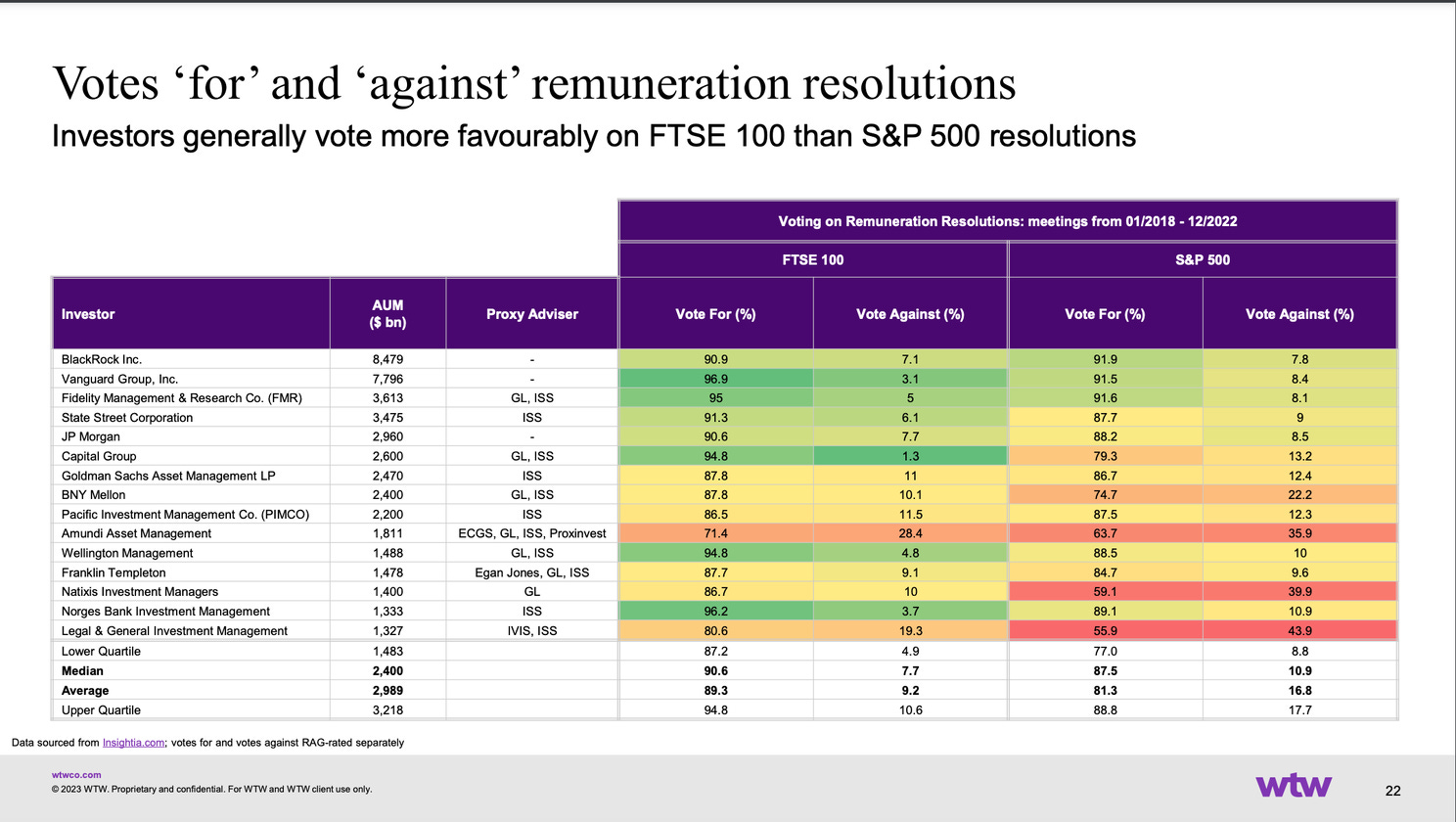
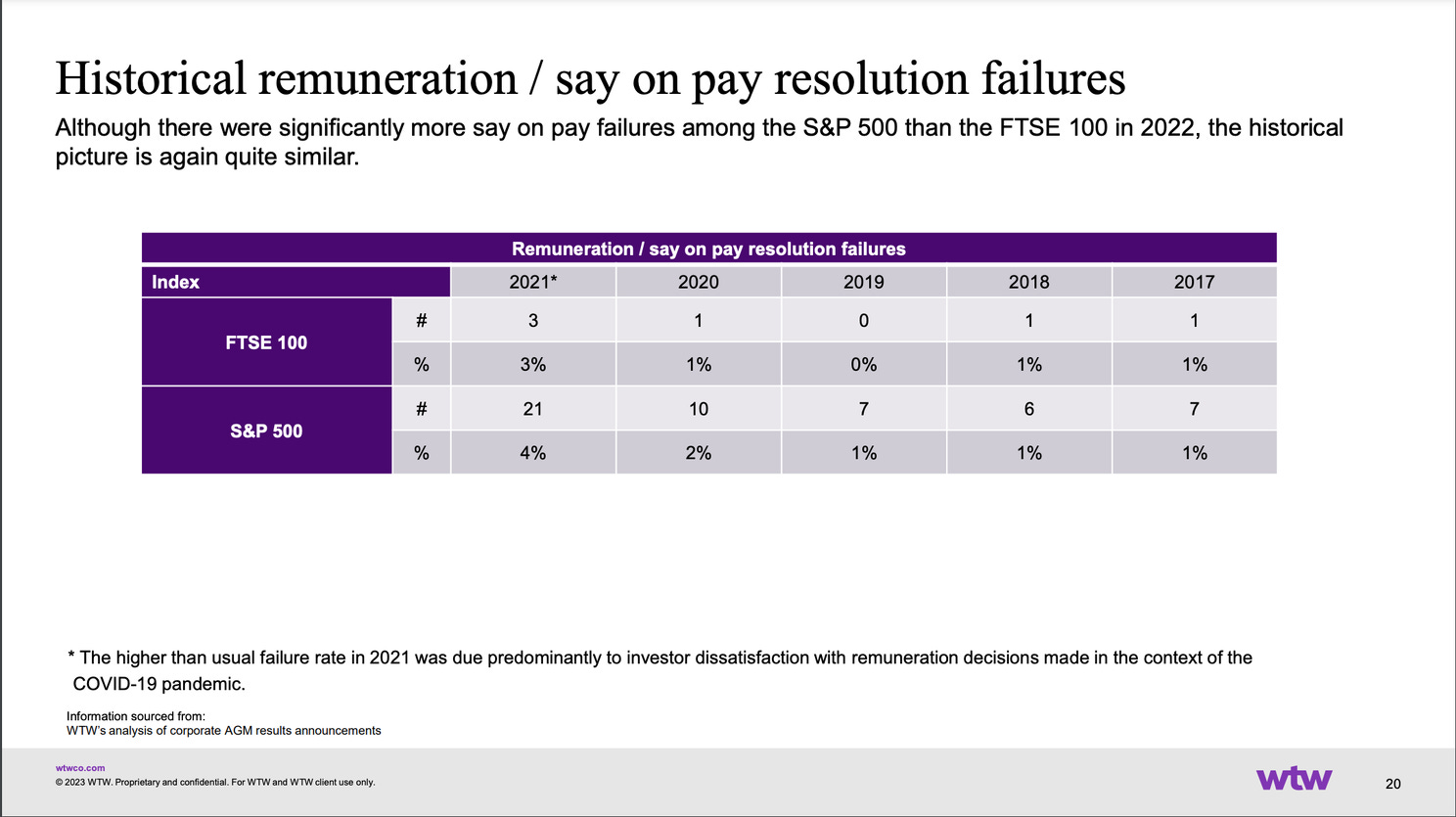
So actually major investors - shareholders is many UK PLCs - challenge companies in the US more often, and companies are very unlikely to lose a pay vote in any case. If we were to take this evidence at face value it suggests that the argument that the UK is being held back by over assertive shareholders is not a very strong one.
I know that in practice things are more complicated, and votes do not tell the whole story of the genuine pressures companies faced when making decisions about remuneration and recruitment. But the proxy voting point is one that critics of current practice chose to make and on its own terms does not seem well supported by evidence that they have commissioned. I don't think I have seen this acknowledged.
More recently, as part of the Autumn statement, the CMIT floated other ideas, such as scrapping the Investment Association register of significant votes, and indeed scratching the idea that 20% against should be treated as significant. And more generally there is a concerted effort underway to 'liberalise' listing rules, which in practice means reducing shareholder protections. These things being seen as troublesome clutter on the path to competitiveness.
So perhaps it is worth invoking the paradox identified by GK Chesterton:
In the matter of reforming things, as distinct from deforming them, there is one plain and simple principle; a principle which will probably be called a paradox. There exists in such a case a certain institution or law; let us say, for the sake of simplicity, a fence or gate erected across a road. The more modern type of reformer goes gaily up to it and says, “I don’t see the use of this; let us clear it away.” To which the more intelligent type of reformer will do well to answer: “If you don’t see the use of it, I certainly won’t let you clear it away. Go away and think. Then, when you can come back and tell me that you do see the use of it, I may allow you to destroy it.”
I've been knocking around long enough to remember why the 20% threshold was brought in. It was because some PLCs were routinely receiving very high, but not majority, votes against their executive pay arrangements and continuing as if this did not matter. Ladbrokes response to such a vote in 2011 was a classic of the kind: "We have noted the disquiet expressed by some of our shareholders and have recorded it for future reference."
Similarly, investors spent years eliminating dual class shares from the UK market because this was seen as a significant governance risk to minority/outside shareholders. Are we certain that is a fence we wish to tear down, and are we confident that those who advocate its removal understand why it was there in the first place? (And as an aside I am amazed that the experience of NMC and Finablr is totally absent from the discussion about listing rules.)
Regrettably I think we are in a place where, because those doing it are often at a very senior level, vibes-based policy advocacy is actually having an impact. The least we can do is call it out.