Social Factor snippets
Reversing over DEI targets, "The name's Bond... (but the holding is equity)" and a gloomy quote

Earlier in the year I wrote a piece about ‘ESG’ targets in executive pay and why, despite my scepticism about their effectiveness, I wouldn’t waste time trying to remove them. Now we are starting to see some companies do exactly that. Specifically they are removing targets relating to diversity, equity and inclusion and it seems likely this is in at least in part in response to criticisms from some anti-ESG activists.
There are some reasonable grounds to have doubts about such targets. For example, a target in an incentive scheme of increasing the number of women in senior positions might risk rewarding the direction of travel and thus risk rewarding (often male) executives for things that were already going to happen, or should do.
However I think the point that was made to me when I queried the value of safety targets in incentives holds here too. They might not do a lot, but they are a signal to people working in the business that this issue matters. Again, even if you are still sceptical about the positive impact (as I am in relation to safety) think about what message it might send to actively remove such targets once in place. Surely this must be hugely disheartening for anyone from an under-represented group that works for the companies that are taking DEI targets out of pay schemes (sometimes alongside a broader retreat).
It will be interesting to see whether those investors that have been encouraging companies to add ESG targets into incentive schemes are going to approve remuneration policies that have now removed them again. My guess is not.
I thought this great Alphaville piece on the rise of fixed income ETFs deserved a plug. It also prompted me to go and have another look at stock-lending in fixed income ETFs, so I’ve had another trawl around. It looks to me like there might be some regulation around reporting on this as I can find quite a lot of info which seems to be semi-standardised.
Just one example below is the proportion of a particular UK gilt ETF’s holdings out on loan by year to end March over a decade.
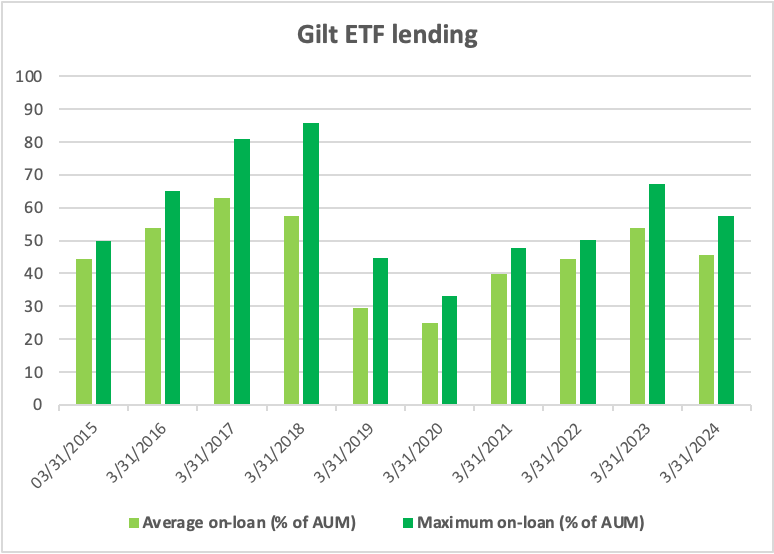
Look at the max on loan for the year ending March 2018, and the average out of loan was over 50% in four out of ten years. According to the data provided a bit over a third of the collateral held by this ETF is equity rather than fixed income, mainly large cap stuff but most of it not UK. It does make you wonder who, if anyone, is voting these shares. And more generally I still find it odd that people invest in things that hold assets very different to the label on the vehicle. I’m finding this quite an interesting area to explore so may poke around further in my spare time.
Looking at recent events around the world it’s hard not to feel a little gloomy. It has reminded me of the passage below from Culture Counts by the conservative philosopher Roger Scruton. Every time I have read his stuff I am reminded a) that there are some conservative thinkers/writers who are really worth reading, who make strong arguments and address opponents’ positions in good faith and b) that I am (spoiler alert) fundamentally not a conservative.
That said, as someone who does not take human progress for granted, the passage below rings true to me.
Human life is conducted on a thin crust of normality, in which mutual respect maintains a genial equilibrium between people. Beneath this thin crust is the dark sea of instincts, quiescent for the most part, but sometimes erupting in a show of violence. Above it is the light-filled air of thought and imagination, into which our sympathies expand and which we people with our visions of human value. Culture is the collective practice which renews those visions and extends our sympathies into all the corners of the heart. It is the ongoing record of the life of feeling, which offers to every new generation the examples, images, and words that will teach it what to feel. But when the eruptions come it can do nothing to tame the violence. Nor can religion do anything, nor can ordinary morality. For violence breeds violence, and anger breeds anger. Good people, whether educated or uneducated, whether aesthetes or philistines, will try to bring order and decency in the midst of chaos, but bad people will always resist them, and in the worst moments of human conflict it is the bad people who prevail. Some of these bad people will be cultivated; some will be religious; all of them will be bent on a path of destruction, consulting their faith or their education only as a source of excuses, and never as an order to stop. No institution, no doctrine, no art that human beings have devised has ever been able to prevent the atrocities that occur, once the crust of normal life has broken. Why that is so is a question for the anthropologist and the geneticist; that it is so has been shown beyond doubt.