
Social Factor snippets
An odd choice of social metrics to measure asset managers, PTV, low turnout

Odd metrics
The Investment Consultants Sustainability Working Group has updated its list of ESG metrics that it expects asset managers to report against. There is an Excel file available here if you scroll down a bit.
The ‘social’ element of the metrics is the shortest of the three, but it’s the content that really stuck out:
Violators of UN Global Compact principles - Number of companies within the portfolio and total weighting of companies as a percentage of total portfolio value that have been involved in violations of the UNGC principles
Along with data source and % of portfolio by weight for which data is available
I am a little confused by this choice. The UNGC is not specific to social issues, although it does lean heavily towards human and labour rights. More significantly, as someone who has done a considerable amount of engagement with companies and investors over social issues, I need convincing that it is common to think of corporate behaviour in terms of adherence to, or violation of, UNGC principles, rather than the underlying rights themselves.
For example, having done a lot of work over the past couple of years on freedom of association and collective bargaining rights, I can honestly say that the UNGC rarely gets a mention. But we do talk, all the time, about the ILO core conventions, the declaration on fundamental rights at work and so on.
One could argue that it would make sense for the ICSWG to strip out the underlying principles in the Global Compact that relate to social factors and ask asset managers to report on violations of those. But even then I think this may result in asset managers disclosing data they’ve bought in from ESG research providers, and I’m sceptical about how well labour rights issues are covered in ESG research in general. Either way, I don’t think what is being requested will tell anyone much that is meaningful about how asset managers are addressing social issues in practice.
The guidance also says:
We also request asset managers consider the recommendations of the Taskforce for Social factors and support investors with increased transparency in reporting in this area
Which is obviously very broad indeed.
I realise the ICSWG guidance is pretty limited in general, and recognise that social issues are harder to measure managers on because of the relative lack of agreed upon standards compared to, say, climate change. Nonetheless the focus on the UNGC feels odd to me, and given that this will send a signal through the investment chain (because managers will want to be able to provide good answers to investment consultants) I think it’s worth flagging it. I would be interested to hear from others working on social issues in RI whether they feel the same or differently.
Pass through politics
I’ve written before about pass through voting (PTV) and some of the different views about it. To reiterate, I don’t really see this as a topic where there is a simple for/against answer. For some clients it seems to me to be entirely sensible to vote themselves, others will feel happier delegating to asset managers and monitoring. And, in common with others, I do think it is important to distinguish between active and passive managers as the for/against arguments do stack up differently in my opinion.
Generally I don’t see a problem with a wider range of voices in voting, but it’s important to recognise that views diverge even amongst people within RI. On that point I was interested to read a thoughtful piece in Lazard’s active ownership report on PTV. It is largely focused on the potential negative outcomes, so I think worth a read for people like me who are more sympathetic to PTV.
There is one bit I think I would query:
Interpretation of fiduciary duty: As asset owners take back voting rights or request pass-through voting, where does the fiduciary duty to the end client lie? In cases of voting on mergers, acquisitions, or significant strategy changes required by ESG shareholder proposals, where does the fiduciary duty lie if the resulting action is value destructive to a client’s portfolio?
As I’ve written before, despite hearing a lot about fiduciary duty in 20+ years in this field I can’t remember any solid ESG-related cases focused on fiduciary duty (in terms of asset owners getting it very badly wrong). I think it would be very hard to prove a single investor’s vote was sufficient to cause an outcome that was meaningfully value destructive and that the outcome was sought in the knowledge that it might cause significant value destruction. Which is what I think you would need to do?
We could flip the point around and ask - given that the very large majority of shareholder votes are cast in favour of management - whether we think there have been cases where a failure to vote against led to value destruction, for example by failing to challenge poor M&A decisions? I think that is much more likely. However, I still think it would be very hard to argue as a breach of fiduciary duty if the institution voting in favour thought the action they were supporting was the right one - even if they were mistaken.
The ESG fiduciary duty bogeyman has always been perceived in terms of trustees or others undertaking reckless actions in pursuit of their own agendas regardless of the financial impact. In my experience that just does not happen. During my career I can’t think of a single pension fund that has got into financial trouble due to trustees pursuing their own ESG objectives regardless of the need to generate returns. But the risk of it has been invoked endlessly.
I have, however, seen a lot of pension funds lose a lot of money in lots of different ways that were not driven by ESG factors, but that were sold to them by their advisers as very prudent strategies to follow.
Low-flying AGM turnout
I’ve developed a bit of a nerdy interest in airline AGMs. Some of those caught by the EU ownership and control rules, and as such need to demonstrate majority EU ownership, have disenfranchised non-EU shareholders. Since the UK is no longer part of the EU this has caused a problem for UK-listed airlines in particular. The Brexit dividend is in two parts a) significantly reduced shareholder voting turnout and b) the creation of what are de facto dual class stocks.
The companies I have been tracking the turnout for are: easyJet, IAG, Ryanair, TUI and Wizz Air. Last year the average turnout across these five AGMs was just under 25%.
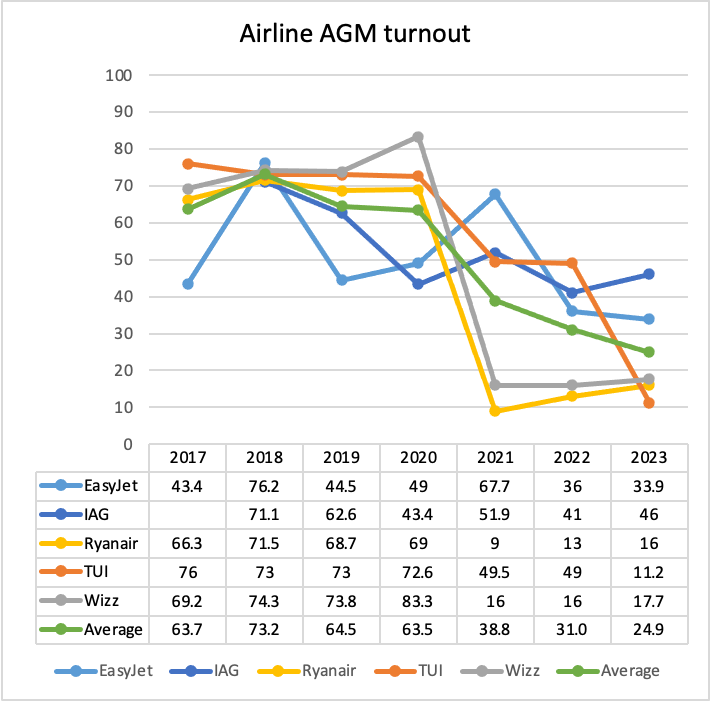
I think it’s possible we’ll see turnover recover somewhat this year, and over the next week we have both easyJet (Thursday 8th) and TUI (Tuesday 13th) with their AGMs to test this out.
The latter one is particularly interesting as there is a resolution on the agenda seeking approval to delist from the UK. Assuming the TUI delisting goes ahead it will also see the disappearance of a unique governance model for a UK-listed company - since the company is incorporated in Germany it has co-determination.