Social Factor round-up
Sisyphean strategies, labour standards and ownership in care, asset manager working conditions part 2, shorting going dark

I’ll start with a question for finance sector campaigners/reformers. An awful lot of effort was put into ‘mainstreaming’ responsible investment in recent years, and on moving the largest asset managers into more ‘progressive’ positions. Under pressure in the US, those managers have now sharply reversed course and that in turn is having a significant impact on investee companies. So my question is: if you even could push the (Black)rock back up the hill, would you still want to? Do the benefits justify the effort, and the risk? I’m genuinely interested in what people think.1
If you have an interest in ownership and labour standards in social care and you weren’t able to join the recent webinar on the topic, the good news is that there is a recording available here: https://mediaspace.nottingham.ac.uk/media/How+can+investors+drive+up+labour+standards+in+the+English+care+sector+Webinar+-+21+January+2025/1_j9g1p90n
And below also the link to the project page which includes the database and dashboard.
Hat-tip to Rights Lab at the University of Nottingham for a great piece of research. I was surprised to see more PE involvement in care in the UK than I had imagined. Also to Friends Provident Foundation for supporting the work and to CCLA for being a leading investor advocate in this field.
I gather that quite a few people were interested to see how the Investment Association positioned itself on the Employment Rights Bill representing the interests of asset management firms as employers. If you liked that, you might be interested to see how some unnamed ‘investment firms’ have been pushing back against diversity initiatives:
Financial chiefs are calling on the City regulator to tear up plans to impose diversity targets in the latest sign of a mounting business backlash.
Banks and investment firms have in recent months ramped up pressure on the Financial Conduct Authority (FCA) with claims diversity, equity and inclusion (DEI) rules would slow growth.
Several bosses have personally approached Nikhil Rathi, chief executive of the FCA, to raise the issue in the hope of preventing the regulator from introducing rules for how companies should treat diversity. Firms have also raised the matter at industry meetings with the regulator.
I was very surprised to see that Labour has allowed a regulatory change to go through that will make short positions far less transparent. Currently you can get a list of shorts in UK stocks from the FCA website which show the size of position (once at 0.5% or above) and the firm that has the position.
I have personally used these disclosures numerous times and do so reasonably regularly. This is how I’ve been able to identify some investors shorting their own clients. This data was also used by Labour in opposition to show BlackRock doing the same thing.
But under new rules although the FCA will receive notifications of short positions it will only be required to disclose an aggregate net short position that does not identify the firms that have those short positions. Here’s a legal firm’s overview of the new rules, and the key point is:
In a major change, only anonymised, aggregate net short positions will now be published by the FCA. This is a departure from the current U.K. SSR and EU law, under which parties holding short positions over 0.5% (and every 0.1% above that in the EU and every 0.2% above that in the U.K.) must be named publicly, alongside details of their transactions.
There’s also a good news report here which includes someone making the point that - of course - there will still be a requirement for long positions above certain thresholds to be made public.
I really don’t get why Labour let this pass. The arguments for the reduction in transparency seem very weak and the beneficiaries are primarily going to be hedge funds that want to short UK stocks without being identified. I fear Labour’s desire to show it is serious about boosting growth risks being far too credulous when requests to weaken or remove regulations come in.
Competition policy is another area to watch. In the US, Lina Khan is out of the FTC, much to the delight of Big Tech. And in the UK Labour recently forced out the chair of the CMA. Once again the need to boost growth is invoked.
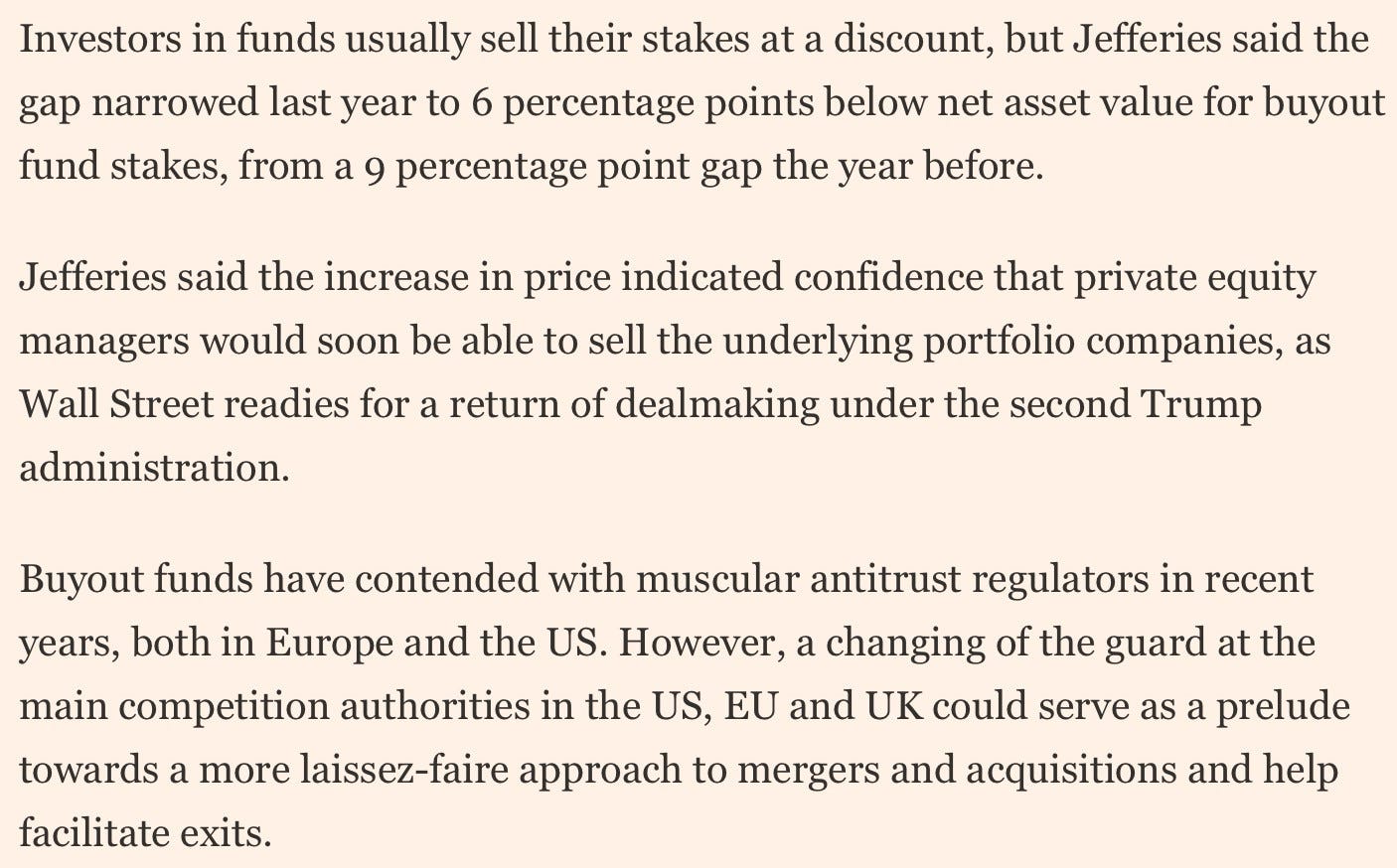
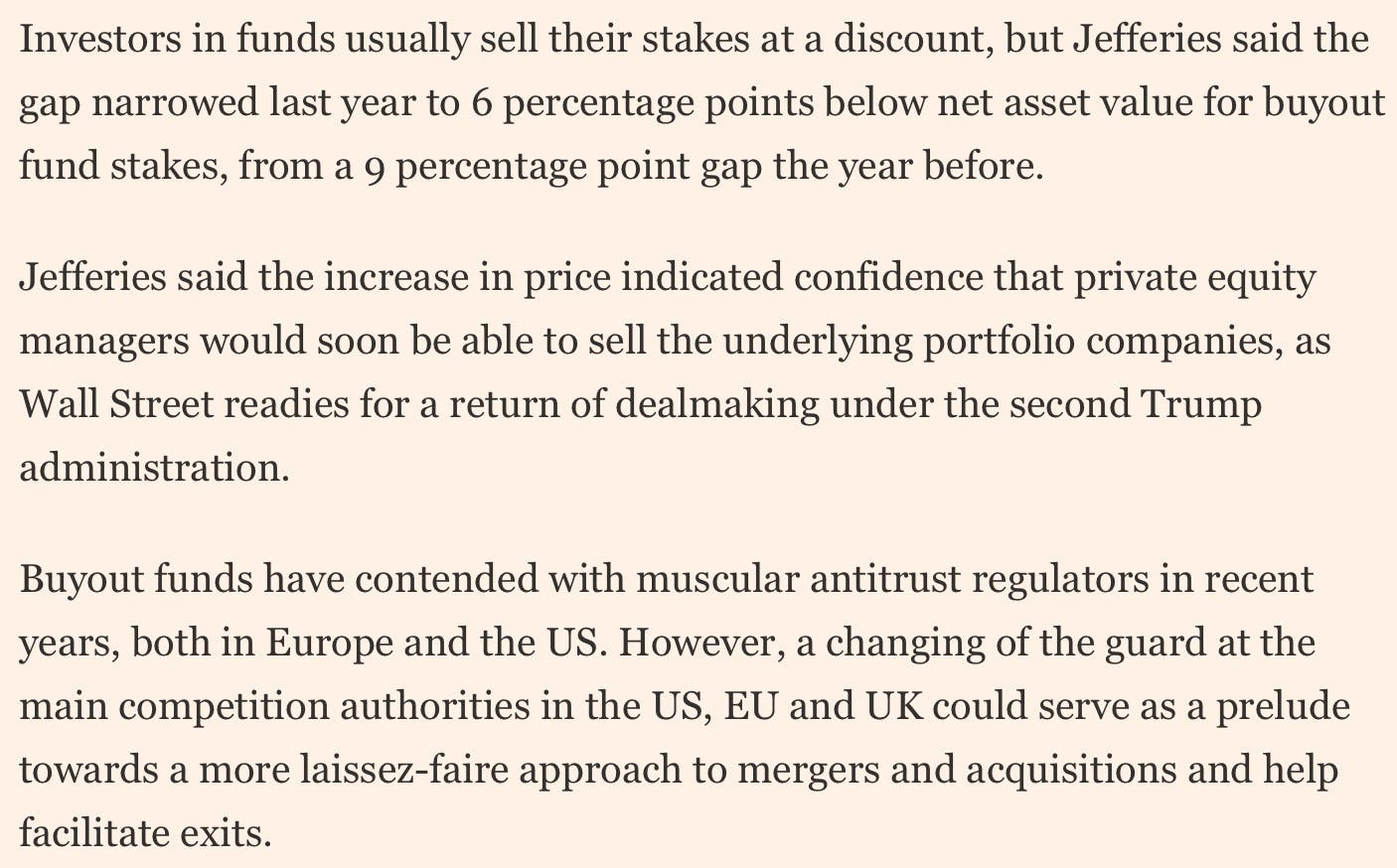
And once again a subset of financial firms may benefit. There was a very interesting piece in the FT on investors selling on record numbers of private equity positions in the secondary market in order to generate a return. This is in lieu of opportunities for exit via IPOs or other deals and, whilst it seems to be LPs mainly, it includes GPs selling stakes to other of their own funds.
While there’s usually a steep discount for this type of sale apparently it has reduced as private equity is expected to benefit from a change in competition policy in the US, EU and UK.
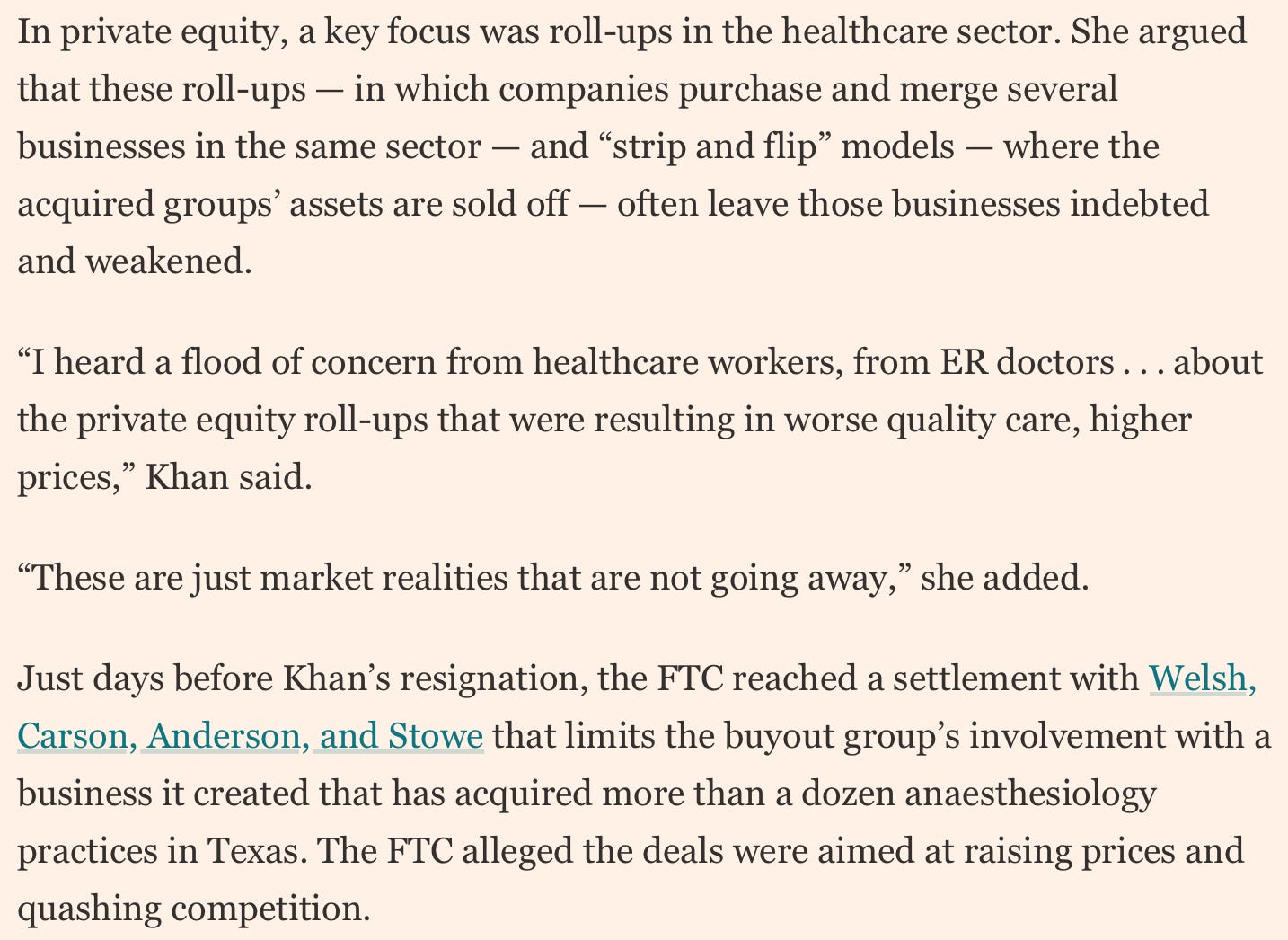
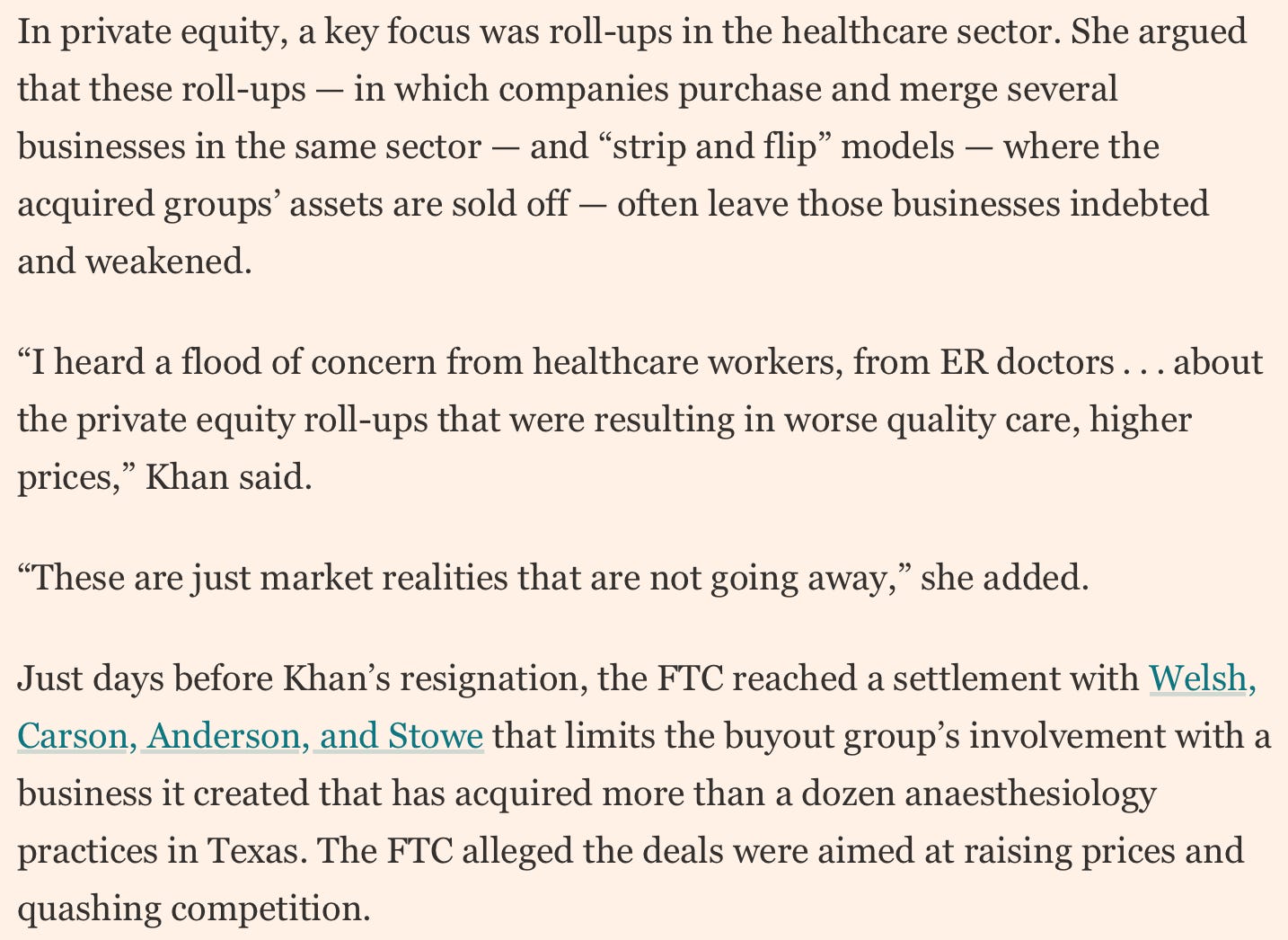
Notably Lina Khan warned of the anti-competitive role of private equity on her way out.
Time to up those private market allocations, right?
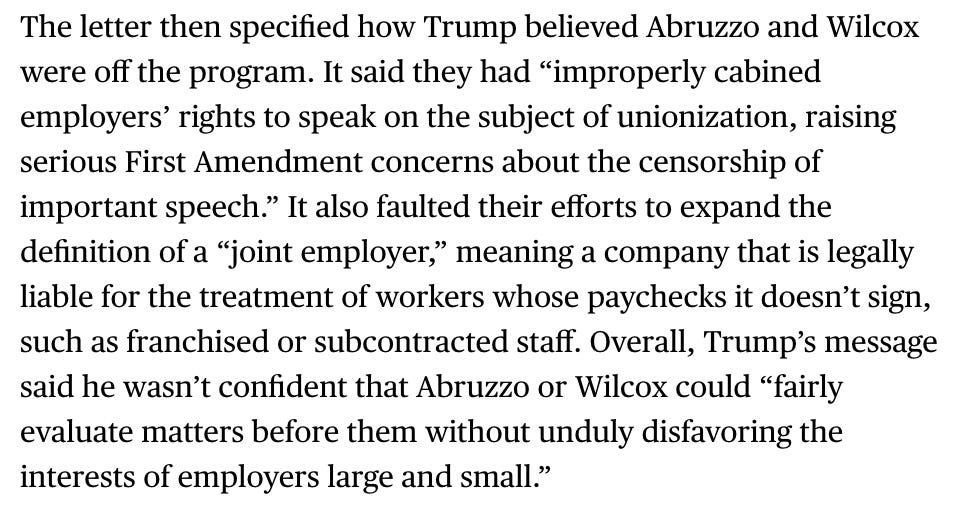
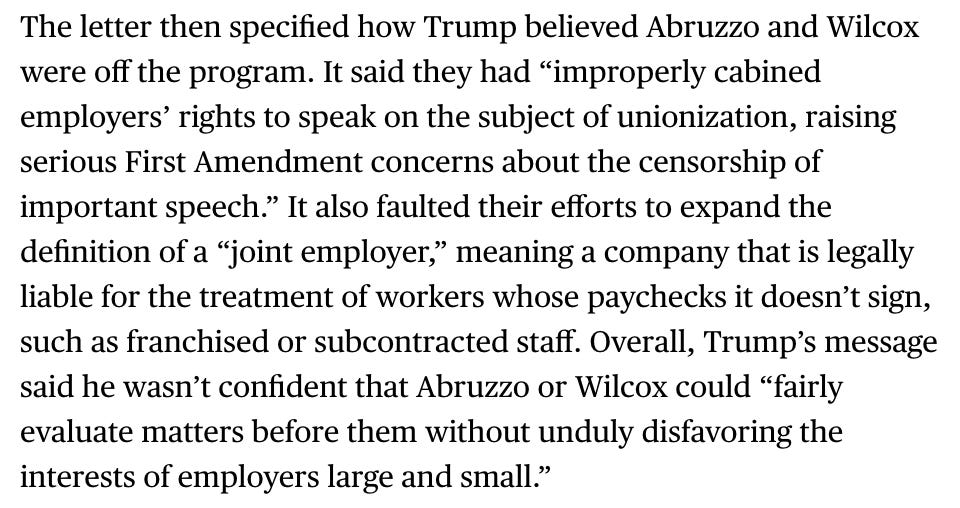
The chaos in the US is hard to keep up with, but the direction of travel is already clear. Already the acting general counsel and a member of the board of the National Labor Relations Board have been forced out. The explanation given for these actions is interesting.
Keep track of developments here. And could OSHA, the US safety regulator, be next? This might just be a fringe politics for now, but given Elon Musk’s antipathy towards OSHA during Covid the risk is not zero.
Finally, on a potentially more positive note, a news piece from a couple of weeks ago on how the ISSB found that investors increasingly want better workforce-related data and reporting.