Social Factor round-up
M&A, corporate governance reform, union avoidance consulting

M&A
A couple of bits of M&A related material to kick off. First, there was some interesting stuff from the FT recently on the lessons of the Vectura takeover by Philip Morris, now that the latter is selling it on for far less than it bought it for. Helen Thomas wrote a good piece questioning why the board of the target company thought the takeover was a good idea, given the business the acquirer is in. A key point on the deal is as follows:
It would have been “entirely proper”, one senior deals lawyer told me at the time, for Vectura’s board to take into account that PMI might not prove a suitable owner for the business. Other advisers, and chairs who have been in that situation, argue that in the room the advice is almost always that price wins the day.
The last sentence tallies with what I have heard from various people over the years about what the takeover process is like. If I was a PLC director in a takeover I think I would be far more worried about getting it in the neck for not getting a good price for the business rather the risk that someone tries to get me under directors’ duties for not considering the nature of the future owner. Almost all the focus from all parties is on the price.
As I’ve written before, you will search in vain for a clear policy steer for directors or investors to take a lofty approach to these questions. M&A doesn’t really appear in the Corporate Governance or Stewardship Codes. Similarly, most investors’ own stewardship policies are circumspect. In practice, everyone knows that price determines the outcome most of the time and everyone is primarily in the business of making sure they get their ‘fair’ share.
Of course, all this exacerbated by the reality that share registers get churned up during takeovers. Out go the ‘long term’ holders and in come the investment banks and tethered to them their hedge fund clients with their synthetic interest in the target built up through derivatives, but who seem to expect to be treated as if they were shareholders.
Relatedly, I found this filing which shows that TIG Advisors and Berry Street Capital - two firms I have come across several times before in the merger arb world - had committed to vote in favour of the Carlyle-proposed takeover Vectura, which ultimately got bazooka-ed by the PMI offer.
Bidco has received irrevocable undertakings in relation to voting in favour of the Scheme at the Court Meeting and the resolutions to be proposed at the Vectura General Meeting from AXA Investment Managers UK Limited, TIG Advisors, LLC and Berry Street Capital Management LLP in respect of a total of 67,133,559 Vectura Shares representing, in aggregate, approximately 11.2 per cent. of the issued ordinary share capital of Vectura as at close of business on 5 August 2021.
If they were going to vote in favour I think they would have had to either a) acquire the underlying equity or b) put in place an arrangement with a counterparty to vote the shares.
According to this filing TIG Advisors had a derivative interest (rather than shares) in Vectura on 30 July, and according to this one from 22 July so did Berry Street Capital. And note this latter one identifies that the position utilised cash-settled derivatives (meaning no expectation of acquiring the underlying equity). Obviously both could have acquired the equity in between the date of these filings and the statement from Vectura. But it doesn’t look to me like either firm was actually a shareholder a week or so before the Vectura statement above.
Perhaps, then, it was actually a pledge to find a way to be able to vote by the time of the meeting. It didn’t matter in the end in this case but it does remind me of the shenanigans around the Melrose / GKN takeover, a deal which succeeded with the narrowest margin. In particular, this snippet (I think it was from The Sunday Times) has always stuck with me:
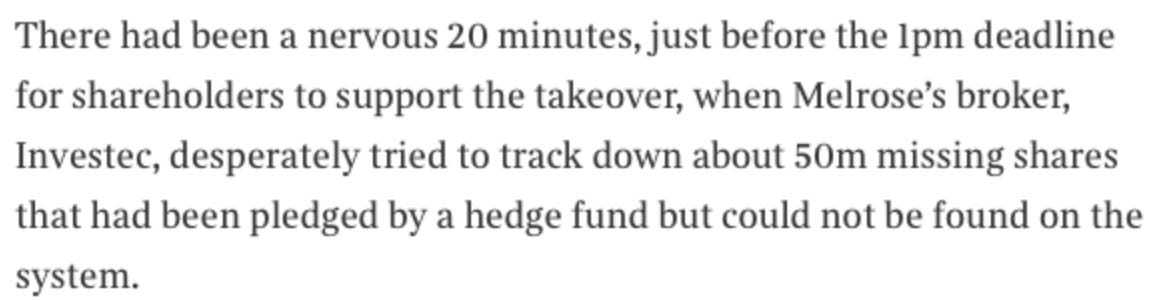
“pledged by a hedge fund” eh?
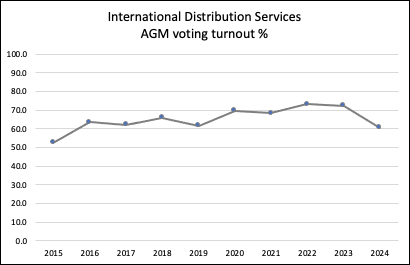
Secondly, a snippet on IDS (better know as Royal Mail) which had its AGM last week. I can see a bit of hedge fund action around the margins of IDS (example here), so thought I’d take a look at the AGM voting turnout compared to previous years. Turnover had been broadly trending up in recent years and was over 70% in 2022 and 2023. This year it fell back to 60%-ish. That’s consistent with a chunk of votes being taken out of action due to derivative interest starting to pile up, though not proof that is what is happening.
Shareholder primacy and business investment
Next up, corporate governance and business purpose. There’s an interesting piece here by Common Wealth in collaboration with Demos (two UK think tanks) on shareholder primacy and (the lack of) business investment in the UK. The whole thing is worth a read, but here are the recommendations:
Make purpose-led businesses the legal default in the UK through a reform to directors’ duties to articulate a new purpose for the company, as called for by the Better Business Act, a campaign for corporate governance reform with close to 3,000 businesses as part of its coalition. This reform would ensure decisions are made with multiple stakeholders in mind, promoting a more long-termist and less narrowly extractive outlook.
Commit to worker representation on company boards, as called for by the TUC.
Expand company membership to allow employees to vote at Annual General Meetings to ensure both labour and capital investors in the corporation are represented.
This also makes me think about the nature of the discussion around stewardship currently. There has recently rightly been a reaction to over-claiming and over-use of ‘win-win’ arguments. In turn there has been more scrutiny of when stewardship is effective - and legitimate - or not. Put simply, some things that society might consider desirable might not align with generating profits, and return for shareholders. Therefore, the argument follows, it might not be legitimate for shareholders to pursue those objectives.
I think what is less appreciated is that while some might stop this line of argument at “shareholders cannot legitimately pursue these objectives” others might continue it to “therefore shareholder interests should not have primacy”. I’ll come back to this one at some point.
Poacher turned game survival assessor
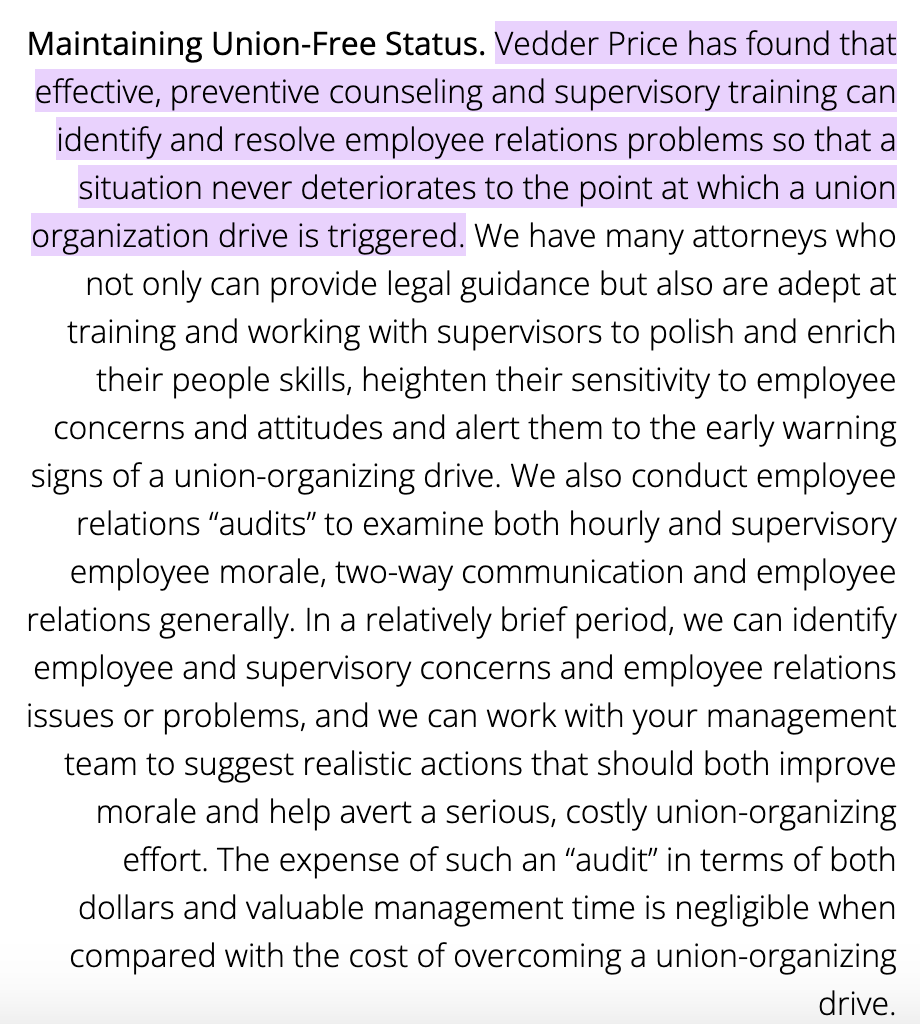
Finally, labour rights, and I can’t get over this one. US company Maximus appointed a law firm to undertake an assessment of its approach to Freedom of Association. The firm it chose to do the work was Vedder Price, which offers union avoidance services. This is not hidden - it’s very easy to find info on the firm’s website with a quick Google. I personally feel that the fact the company utilised this firm to undertake such a review is very illuminating.