
Social Factor round-up
Silencing worker voice, Mercedes threatened by US politics, pension fund democracy

Silencing worker voce
I’ve seen two interesting pieces from the Economic Policy Institute in the US over the past few weeks that address the weaknesses in US labour law regime.
First, there’s a great briefing on the use by employers of “union avoidance” specialists, usually law firms though not always. These advisers help companies implement strategies to undermine employee support for unions, challenge successful union elections and so on. The spend by individual companies can be significant, and bear in mind that we might only be seeing part of it. Look who is top of the list.
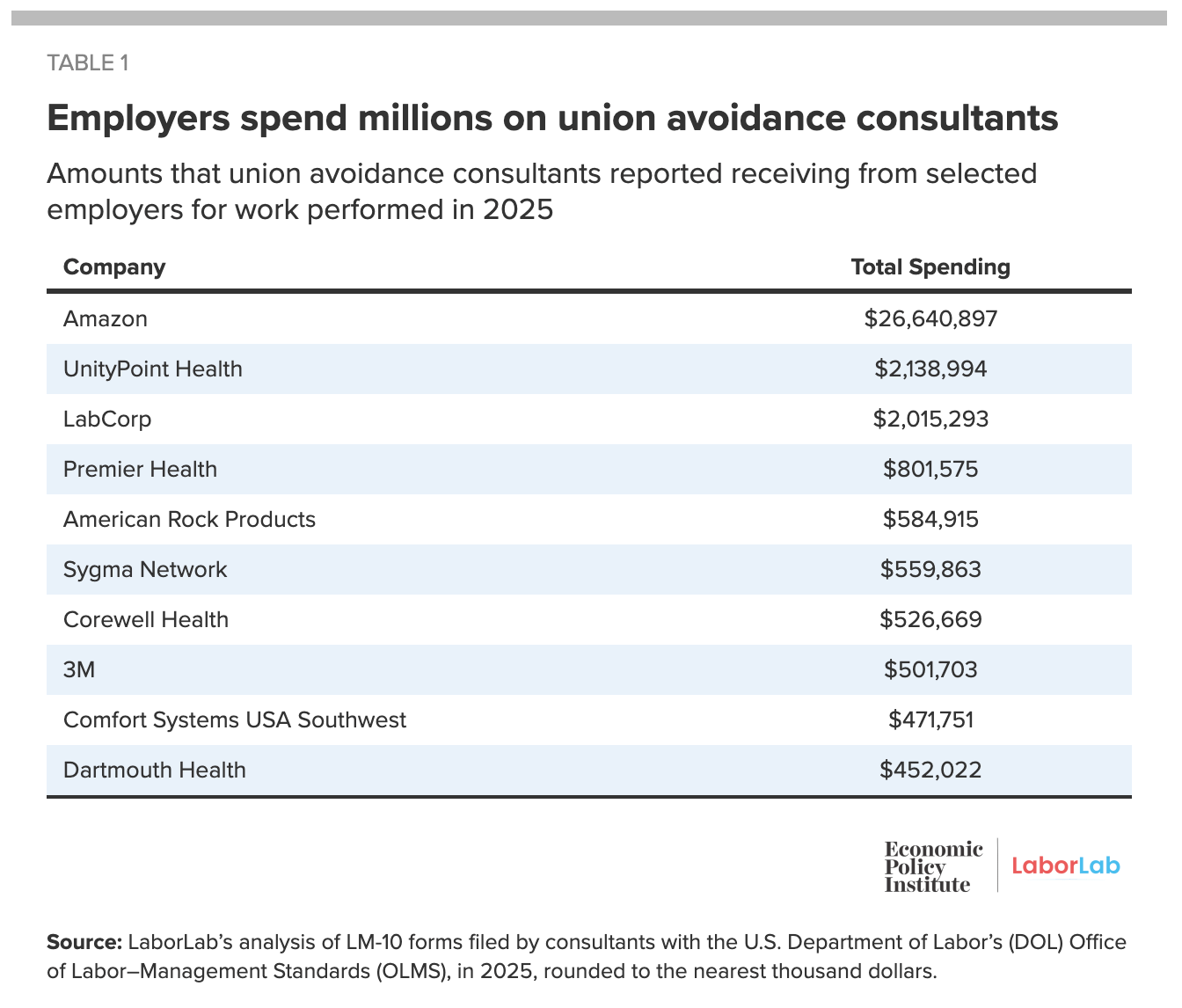
To be clear, a core function of this advice is to dissuade employees from exercising their rights. Therefore I think such advisers should properly be considered as supporting “human rights avoidance”.
Put in those terms I’m amazed that this industry does not attract more scrutiny and challenge. If you’re an investor with a policy commitment around human rights I think there is an interesting engagement project here that could encompass both company and policy engagement.
Of course, the deliberate obstruction of employees’ rights does not only occur during the unionisation process, it can also affect bargaining. This is really important, because it’s in the process of bargaining that workers should gain the benefits of unionising. One of the striking features of the US market particularly is the length of time it takes to get to a first collective agreement.
Employers will often provide reasonable-sounding explanations for why this takes so long, not least the complexity of negotiations. So the EPI took a look at how long companies took to complete mergers - presumably also quite complex!
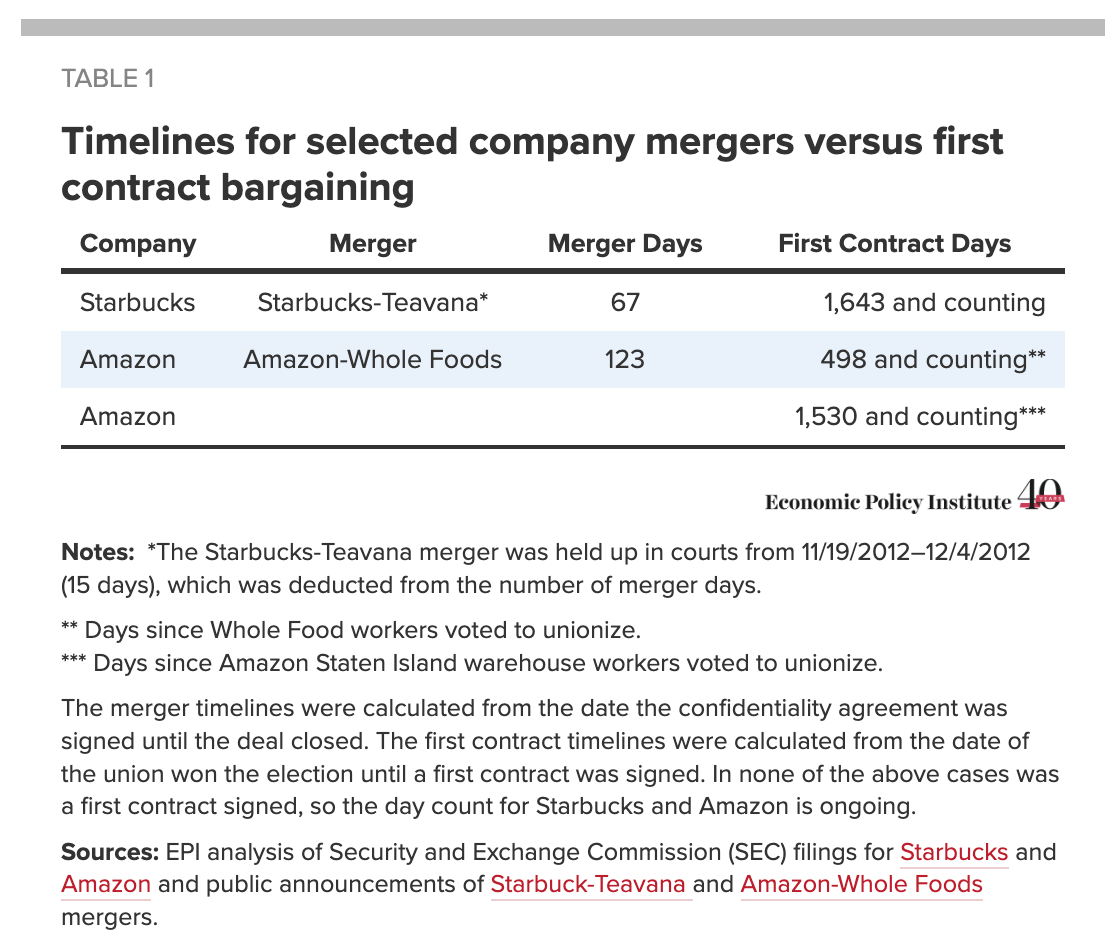
Just focusing on Starbucks here, by the end of 2026 it will have been five years since the first store unionised. I do not underestimate the potential complexity of contract negotiations in such a large employer but is it really more complex than a merger?And does it really require half a decade?
To put it in context using a current example, as things stand FIFA will have held two World Cups involving 54 unique teams and 168 games since the first Starbucks store unionised but before a single store has a contract in place. In the same period the entire series of both Squid Game and Andor have been released and the UK has had four prime ministers… so far.
To me it is not credible that it requires anything like that amount of time to reach an agreement but the legal enforcement is sufficiently weak - and further weakened under the current administration - that companies can drag their heels.
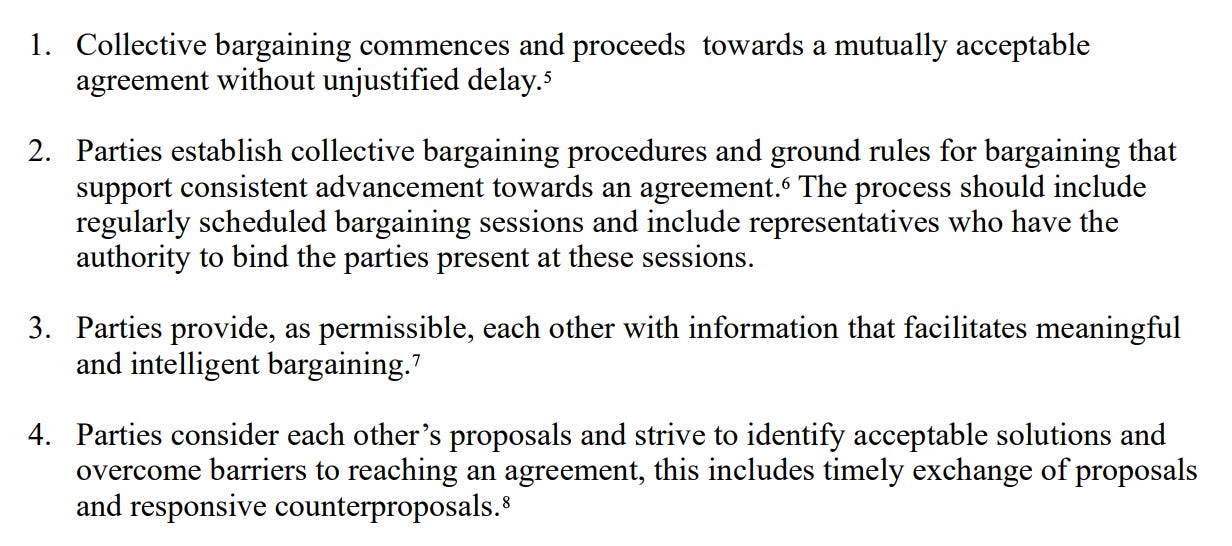
Again, there is an engagement opportunity here. A group of investors has already articulated a set of principles on collective bargaining that are a useful resource:
Interestingly, there is a cross-party initiative to address this. The bipartisan Faster Labor Contracts Act was just this passed in the House of Representatives with not insignificant Republican support (there’s an interesting piece on ‘pro-worker Republicans from Oren Cass in the FT here). The bill seeks to dramatically reduce the time taken to initiate and conclude bargaining: ten days to start negotiations, 90 days to conclude them.
It realistically likely won’t get further whilst Republicans control the Senate and the Presidency, and the numbers in their ranks who are supportive of this initiative are limited, but it’s notable that it got this far in this political climate.
Mercedes threatened by US politics
In another case of an unexpected cross-party consensus in the US having ramifications for companies, next here’s an example of a major multinational getting caught up in geopolitics. There is a bipartisan bill in progress that seeks to limit “foreign adversary” involvement in car manufacturing in the country.
According to CNBC:
The bill, the Motor Vehicle Modernization Act of 2026, would prohibit automakers that have “any direct or indirect equity interest by a foreign-adversary government,” such as China, from importing, selling or manufacturing vehicles for sale in the U.S.
That’s a particular problem for Mercedes because its top two shareholders, holding about 20% between them, are Chinese.
Again, there’s a long way to go with this one, and in my experience companies caught up in these kinds of foreign ownership rules will go to exceptional lengths to get around them. Think about how airlines dealt with EU ownership and control rules. But it does look like a headache for Mercedes.
Pension fund democracy
A well-deserved plug for NEST’s ground-breaking member assembly, the recommendations of which were published earlier this week. There is a press release on the report of the assembly here which includes a link to the report itself.
Here’s a snippet from the announcement:
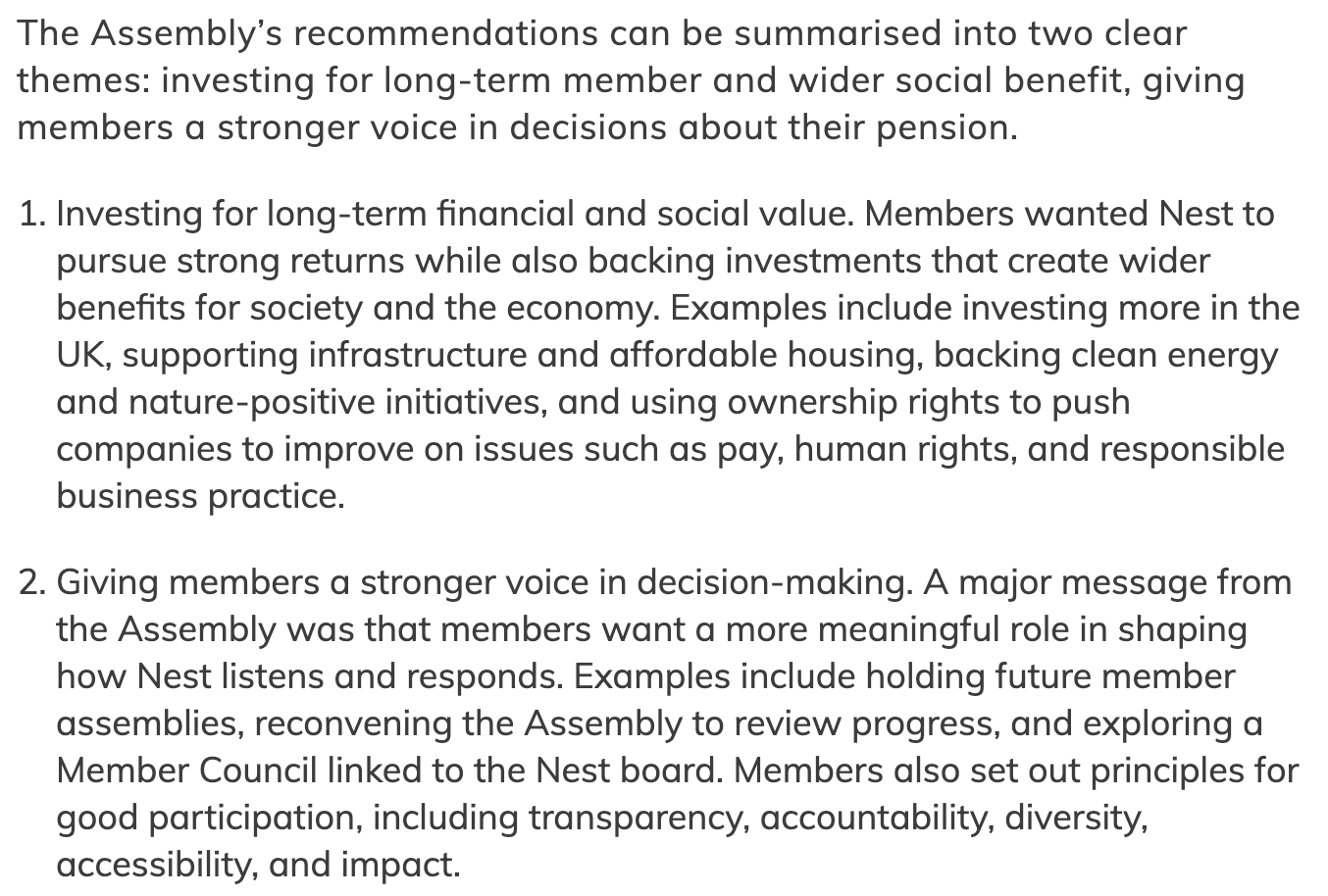
I won’t summarise the recommendations as I have a bunch of biases and I am more interested in hearing what others make of it. I will say some of the recommendations that came out strongly were surprising, which to me is obvious value of the initiative. We are all guilty of assuming we have a good handle on what beneficiaries really think. We could just… ask them.
I have made this comment to several people already, but the make up of the assembly itself was so different to the circuit of ESG/RI events many of us are familiar with. It was much closer to my experience of meetings of union reps and members. People brought unfiltered opinions. A big part of this is down to the design of the assembly and I’d encourage anyone interested in this to check out the work of Dr Emmeline Cooper.
There was an important part of the process for those of us talking to particular topics at the assembly - we were given a clear steer to explicitly identify trade-offs. I personally think this is crucial in order to ground the exercise in reality. That said, in the groups I spoke to there was already an innate sense of this. Views on zero hours contracts, for example, were not uniform even amongst relatively low-paid workers.
It has been one of the highlights of my time working in this field to be part of the assembly. My experience of it was really positive and enlightening. I remain very hopeful that bringing ‘ordinary’ people of mixed backgrounds and views to deliberate and be part of initiatives that actually result in change are a vital part of the response to grievances that fuel populist politics.
NEST will be the biggest pension fund in the UK in the not too distant future and already has millions of members. As such it has done something really important here in establishing the idea that those whose capital is being invested, and will be affected by decisions about how this is done, deserve to have a voice. Hats off to the NEST team for taking the initiative.
Populism in pensions
After the local elections last month I flagged a number of funds that would likely see a shift in political control, and in the populism and RI event last year I said West Midlands Pension Fund was one to watch.
Well, it is now pretty cleat that, as expected, it will no longer have a Labour majority on the committee. You can see the appointments to the committee so far here. But here’s the breakdown as it stands (there will be a few more appointments yet).
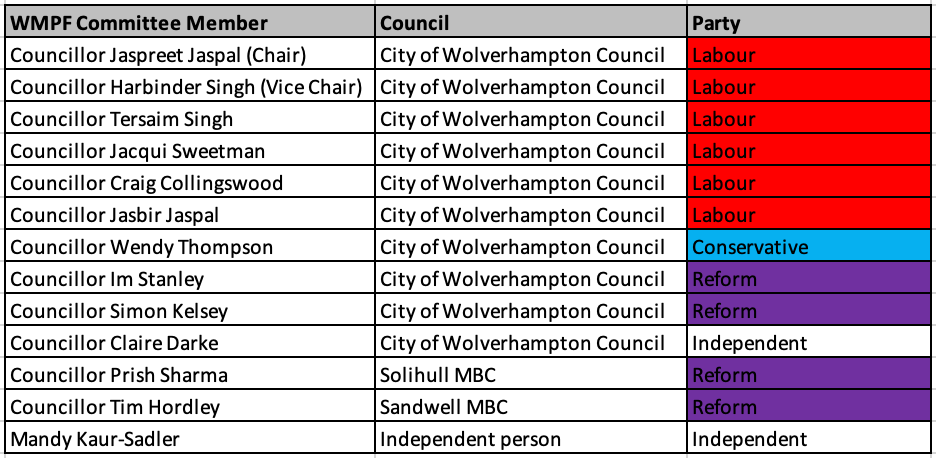
There are several more appointments to come but just to note that it’s only really Coventry that would be likely to appoint a Labour councillor. Meanwhile Reform swept the board in Walsall, so I assume they get that one. The Conservatives are the largest party on Dudley council, followed by Reform. The Conservatives lead the council as a minority administration so I’m guessing they will take the WMPF committee position. Birmingham is… complicated, but could end up with a Green or Lib Dem representing it on WMPF.
So my guess for the final make-up is something like:
Labour - 7
Reform - 5
Conservatives - 2
Independents - 2
Lib Dem or Green - 1
Finally, just a quick word on the Makerfield by-election and what it might mean. The interesting element for me is the combined Lib Dem and Green vote. In 2024 between they got about 11% of the vote, or around 4,500 in total. Yesterday’s figures - on a higher turnout - were 1.1% and 471 votes. No doubt Andy Burnham’s personal popularity is a significant factor, but it’s not just that. As it stands, tactical voting is going to really hurt Reform come a general election. This is also another by-election, after Gorton and Denton, where the party has failed to break through.
This does not mean, at all, that the populist Right is in retreat. Farage has overcome many setbacks before. In addition, we should be prepared for Reform to win more councils. They have a bedrock of support nationally that has not found expression in local elections in all regions yet, because of the staggered nature of local elections.
But after a period of seemingly ceaseless forward momentum they are experiencing some real difficulties. As the man said, it is, perhaps, the end of the beginning.