
Social Factor round-up
Reform UK and the LGPS, Thames Water politics, the passive massive + how BlackRock makes money, Living Wage campaign and a shameless request for support

Reform UK and the LGPS
I’ve been trawling through council websites in my spare time trying to get a sense of to what extent Reform UK’s success in the May local elections might impact the LGPS. Toby Nangle’s pieces for FT Alphaville made the important point that it’s not a simple read across from winning control of or being the largest party on the administering authority to clear control of the pension fund.
Having dug into this a bit and looked at 11 different councils clearly affected by the May results, I think there are eight funds where Reform UK now has the chair of the pensions committee. Of those there are seven funds where Reform UK councillors account for 50% or more of the pension committee.
To get a sense of whether this is likely to lead to changes in the approach of the funds to ESG issues I’ve read through the minutes of one fund with a Reform majority and chair and watched a pension committee meeting recording for another. In both cases these were the first meetings the funds had held since Reform took control.
In the first case, councillors asked whether it was a legal requirement to have a DEI policy and plan and what evidence there was that ‘environmental’ investments delivered value. The latter point was made by reference to the financial needs of scheme members. This fund has an allocation to a climate-themed product.
In the recording of the other fund’s meeting there was one sceptical question about an ESG topic from a Reform councillor but no sign of any co-ordination yet. The Reform chair seemed pretty much like a thousand other local councillors I’ve met - not very Big P political and seeming to lean on the officer for support. It was notable that there was senior representation from the relevant LGPS pool at this meeting too.
It really is not much of a stretch now to imagine Reform-led councils taking action in relation to pension funds. This week both Durham and West Northants councils have scrapped their Net Zero commitments. It seems unlikely that, having made such public interventions at the council leadership level, they will simply overlook what positions the respective pension funds are adopting.
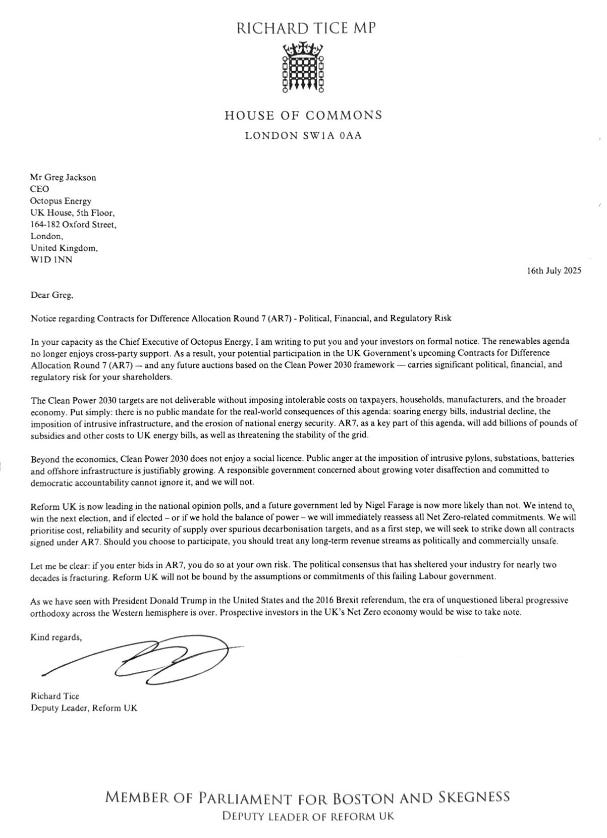
Outside of local government, it is notable that Richard Tice’s letter this week to a number of energy companies stating that Reform would scrap subsidies (actually it’s something a little more technical) for renewables refers to “significant political, financial and regulatory risk for your shareholders.” This suggests that they may be looking at an investor angle.
Looking more widely, I’ve been continuing to poke around in what groups on the Right are saying about ESG issues. My suspicion is that, in common with the US, they will start to target ‘DEI’ as a cost and obstruction alongside the anti Net Zero messaging. There looks to be some positioning going on around equal pay, for example. Something to keep an eye on.
Thames Water politics
I’m really interested in the politics around Thames Water. When Labour came into power last year it was very clear that it did not want to nationalise Thames Water, citing upfront costs. Instead it has sought alternative ownership options while engaging in some frankly rather theatrical stuff around bonuses.
But after KKR dropped out of the running to buy Thames it has looked more likely that it could be at least temporarily brought into public ownership.
I think the political considerations around nationalisation are shifting. Labour is not popular and to the extent any particular policies have cut through they are negative. I do wonder therefore if Thames Water provides an opportunity to do something big.
In light of this, I was interested to see John McTernan, not historically someone on the left of Labour to put it mildly but someone very interested in winning elections, advocate the following:
If I were advising Keir and Rachel on a reset, I’d say, “Just go for it! Use the power of government to intervene for the public good. Call up Thames Water and tell them you accept they can’t carry on doing business under the current regulatory machine. And that’s why you’re nationalising them. You’ll get a bargain basement asset that can generate you a return. And you’ll show the voters that you get it – what counts is what’s most social democratic!”
Thames has about 16 million customers. Imagine a letter / text / email going to every single one of them saying the company was now owned on behalf of the public and acting on their behalf. Could include a pledge regarding bills. It could also be renamed Great British Water, to mirror Great British Energy.
Purposeful nationalisation of Thames Water still looks relatively unlikely but the likelihood of it happening has surely increased.
The quote below is attributed to Milton Friedman, who I am sure would appreciate it being cited in reference to public ownership…
Only a crisis - actual or perceived - produces real change. When that crisis occurs, the actions that are taken depend on the ideas that are lying around. That, I believe, is our basic function: to develop alternatives to existing policies, to keep them alive and available until the politically impossible becomes the politically inevitable.
The passive massive
I often post excerpts from books I’ve been reading, so this time instead I’m posting links to a few videos relating the scale of passive management. More on the academic side here’s an interview with Dimitri Vayanos, Professor of Finance at the London School of Economics. An interesting point he makes is the way that passive contributes to - not just mirrors - market concentration.
And here’s a More Perfect Union video about the Big Three. This one is interesting as it treats ‘universal ownership’ as potentially threatening.
And thirdly (a short one!) here’s Bernie Sanders on Joe Rogan’s podcast.
I think the last clip shows how mainstream the idea that the passive managers have got too big / powerful has become. This is not the first time it has been raised on Joe Rogan’s podcast and it hasn’t just been Bernie Sanders that has raised the topic.
How BlackRock makes money
But while watching videos about passive managers is fun, there is always something worth reading.
As such, I highly recommend this very thorough analysis of how BlackRock makes money and plans to do so in future. This is just the first part of their analysis of the company. Anyone who is interested in the same types of topics as me will very likely enjoy their Substack: This is Fine(ance Capital)
They say that to achieve its objectives or creating value for its own shareholders, BlackRock has five main levers it can pull:
Increasing its assets under management (AUM)
Increasing the base fees charged per dollar of AUM
Holding down operating expenses as revenue increases
Bringing in more revenue from the sale of technology services and other sources
Increasing performance fees generated by funds and/or increasing the amount of AUM invested in funds eligible for performance fees
Point 5 might be where a lot of the action is in future, as evidenced by the firm’s acquisitions in infrastructure (GIP) and private credit (HPS).
This mirrors what is going on in other big managers. I was poking through an LGIM strategy presentation a while back and the emphasis on revenue growth from higher fee products was notable (hence its own involvement in private credit, for example).
Anyhow, well worth a read.
ShareAction Living Wage campaign
A quick plug - there’s a really nice round-up of the ShareAction’s AGM campaign on the Living Wage on their website. As noted previously, this campaign did really well in achieving high votes across the three focus companies. Great work by ShareAction and their co-filers all round.
Shameless request for support
I’m ‘running’ a 50km ultra along the Suffolk Coastal Path in September and using this as an opportunity to raise money for Labour Behind the Label.
I have a couple of personal interests here. I grew up in Suffolk and know that coast very well, and my Dad’s parents were workers in shoe manufacturing in Leicester (I don’t think they made carbon plate trainers…). As some of you may remember, Leicester was where Labour Behind the Label has exposed modern sweatshop work a few years back.
Anyway, if anyone reading can spare a few quid I have a Just Giving page here.