
Snippets

BP’s strategy ‘reset’ will have disappointed many RI people, and it was interesting to see a number of investors call (ahead of the announcement) for a vote on a change in approach. But judging from the sag in the share price, reversing most of the boost that came from the news of Elliott’s interest, it’s pretty clear this is not the end of the story. Already there have been a couple of media stories telegraphing that Elliott wants more, which might mean an ever further turn away from renewables.
At the time of writing there has still been no TR1 notice showing Elliott having a notifiable shareholding. I believe that the pressure it has put on BP, which must have affected its decision-making and its new trajectory, has been exerted through a position built using derivatives. Here’s a description from Hedge Week of this practice in relation one of its other targets:
Elliott often builds stakes using derivatives before converting them to common stock, a tactic that allows the fund to quietly accumulate a significant position before engaging with company management.
I believe at the time of writing that Elliott is not a signifiant shareholder in BP but it is having a much more significant impact on its future orientation than those investors that are. In other campaigns that I have seen Elliott involved in it did not acquire a significant position in the underlying equity at any point. This is activism on the cheap, undertaken by an investor run by someone who donates to the Republicans. And which has its claws into other British companies - including Thames Water.
Does anyone with a genuinely long-term actual shareholding want to fight this? Calling them out on the lack of equity exposure could at the very least force Elliott to acquire a shareholding. That would make its campaign more expensive (and thus reduce its return). But shouldn’t the nature of Elliott’s campaign, and the firm’s relationship to some of the cranks in the US, be making news?
If I were a climate-focused capital markets campaigner I think this would make a juicy target.
An interesting intervention by the American Federation of Teachers calling on the big US asset managers to review their investments in Tesla.
“Tesla’s latest financial disclosures should raise alarms. The company reported an operating income of $1.6 billion for the fourth quarter of 2024 and a 23 percent year-over-year decrease in profits. It made $2.31 billion last quarter, down 71 percent from the $7.93 billion profit in the same period in 2023. Tesla’s vehicle profit margin slipped to 13.6 percent in Q4, missing expectations and underscoring rising cost pressures. These are not isolated incidents but rather a troubling pattern that suggests Tesla’s pricing power is eroding, leaving it vulnerable to market fluctuations and increased competition.”
The full letter to BlackRock is here.
At the time of writing (Monday evening UK time) Tesla stock is down around 25% over the past month. Every day now I am seeing negative content relating to Tesla, whether these are memes about Musk’s far-right turn, reports on protests at Tesla stores, or negative opinion pieces. January Tesla sales in Europe were bad, the full Q1 results could be instructive.
A quick thought on some of the other madness in the US - SEC guidance on shareholder engagement led BlackRock to briefly pause engagement meetings with companies. But even if engagement has restarted, investors are going to be much more careful about what they communicate in meetings, for example in regard to voting intentions.
This matters more than it might appear at first. I have have been in many, many trustee meetings where pressure for divestment (principally from fossil fuel stocks, but also from companies linked to the Israel-Palestine conflict) has been resisted by reference to engagement. ‘If we sell out we will lose our voice’ is an argument that has been routinely used. But if engagement is made toothless - by design - then such pressure is surely much harder to resist?
Something I meant to plug a long time ago is the way a Dutch pension fund developed its responsible investment strategy by convening a group of beneficiaries. This resulted in more emphasis being put on labour rights.
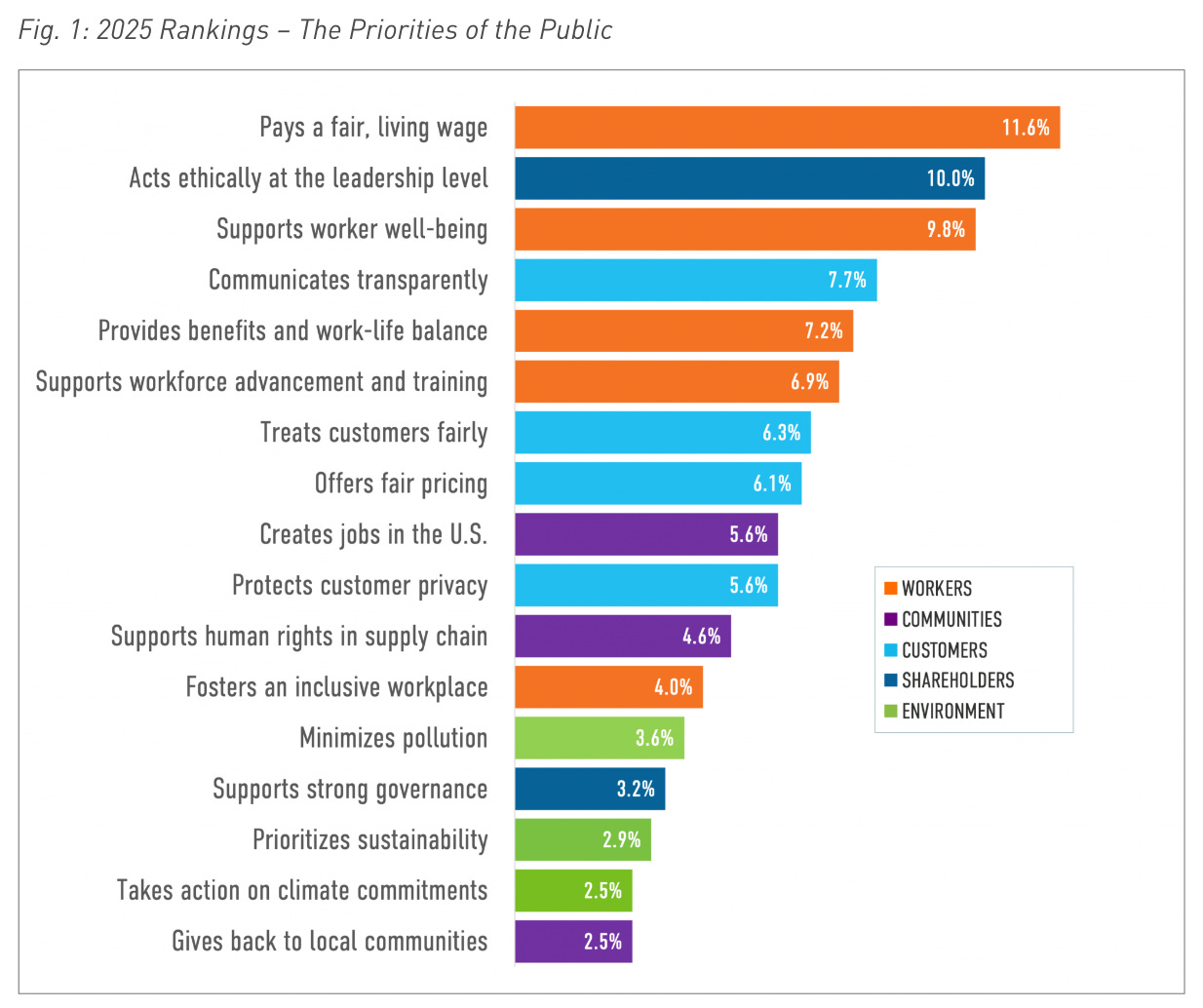
I have seen a few things over the years that have made me think that if beneficiaries were more directly involved in RI development this would result in a much stronger focus on ‘bread and butter’ issues. I think the PLSA (when it was still the NAPF) did some research into the views of DC beneficiaries and found that they would favour a focus on employee terms and conditions. More recently, Just Capital research into Americans’ views of what corporations should prioritise again put employee pay top.
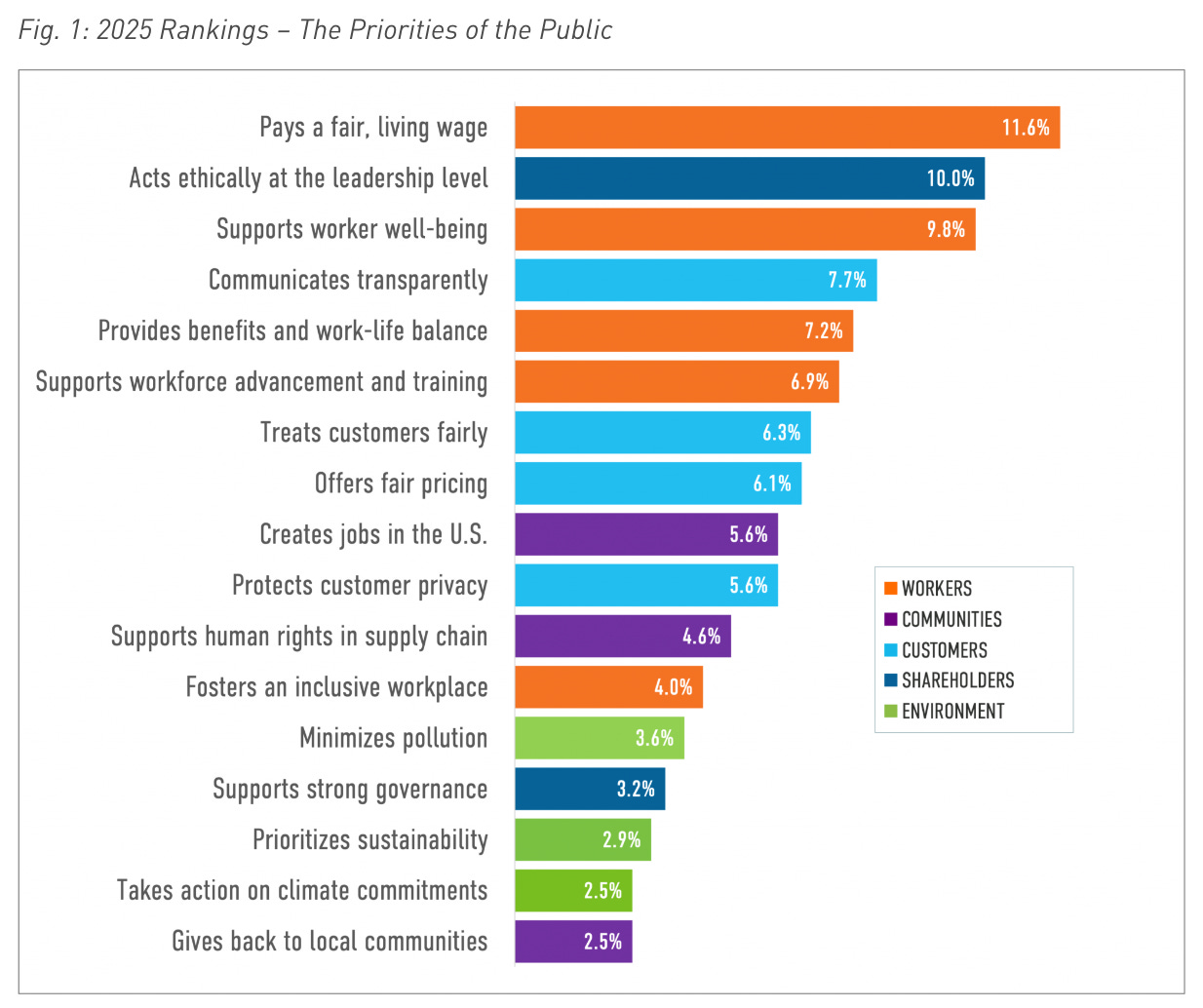
RI as I have seen it practised has these priorities largely the other way up. I do wonder if this is an important reason why it has been very easy for the Right to stir people up against ‘ESG’. Even to someone like me it can look like it is focused on the interests of wealthy, more environmentally-focused people. It does not feel like it has a strong constituency. Perhaps if RI had stronger roots in beneficiaries economic interests it would be more secure.
Finally, some reading material. I’ve plugged Post-Democracy After the Crises by Colin Crouch before. It came out in 2020 but is still relevant. I was recently flicking through it again and thought what he wrote about ‘pessimistic nostalgia’ rang very true (I belatedly realise it probably influenced what I was saying here).
People with a conservative disposition, which includes nearly all of us at times, value stable, familiar things.
When these seem to be lost to us, we experience nostalgia.
In itself, nostalgia is a quiet sadness. It is not necessarily pessimistic or political, and can even be combined with a belief that new good things may replace the old that are fading away. However, when it is pessimistic and that pessimism is politicized, it can become aggressively possessive, identifying and directing anger against enemies who are accused of taking away the life that people remember as having been happier. The anger of pessimists has a different quality from that of those who believe they are being prevented by opponents from entering a new optimistic life that they have never enjoyed. It is necessarily defensive, exclusionary, potentially life-denying, and therefore liable to violent expression.
[T]the backlash against neoliberalism eventually fed into the politicized pessimistic nostalgia that has had the neoliberal project of globalization as one of its antagonists. At one level, a return of protectionism in the advanced world would mark a major setback for the neoliberal project. On the other hand, the relationship between these two powerful forces is ambiguous. This can be seen very clearly in the economic policies of the Trump administration. At one level, its planned return to protectionism threatens global free trade. At another, the same administration has reversed the attempts at re-regulation of global finance initiated by President Obama. Trumpite protectionism leaves neoliberalism's most potent and anti-democratic device - unregulated global finance - free of control. The financial markets therefore continue to be able, through the continuing dominance of the also unreformed shareholder maximization model, to nullify national economic policies. The mining and manufacturing industries that Trump claims to be protecting remain vulnerable to these forces. In effect, the alt.right offers neoliberalism a deal: accept nationalistic restrictions on some of your activities, and the rest will be left free.
Furthermore, the public's rage will be directed away from you and on to immigrants and foreigners. Such an offer leaves the neoliberal business world divided, as the alt.right threatens to introduce not only nationalist economic policies, but also to unleash an uncontrolled, anti-institutional political leadership, which is deeply problematic for business interests.
For its own part, pessimistic nostalgia has successfully challenged the enervating value freedom of neoliberal politics. A striking feature of the Europe debate in the UK was the response of the advocates of Brexit to arguments that the economy would be threatened by such a drastic change in the country's economic relationships. It is not only material interests that are at stake, they argued; it might be better to face some decline in living standards in order to protect national culture and values from dilution by immigrants and to avoid a need to cooperate with neighbouring countries. Pessimistic nostalgia encourages the holders of various values who believe themselves to have been neglected for years to express themselves. If these feelings are deeply felt, a strong democracy must enable their expression.
A new one I’m just finishing is Hegemony Now: How Big Tech and Wall Street Won the World (And How We Win it Back) by Jeremy Gilbert and Alex Williams. This covers some similar ground to Colin Crouch and gets into the struggle between competing accounts of what has gone wrong:
[R]eactionary and progressive narratives competing for voters’ endorsements… do not tell entirely contradictory stories. Both acknowledge the validity of the grievances of those communities ‘left behind’ by forty years of globalisation and Atlantic de-industrialisation (although the reactionary story will tend, of necessity, to exclude the grievances of non-white peoples from their story). Both present strong and active intervention by national governments as the route to redress of those grievances. Both even suggest that some interruption of global flows must be part of the action taken by those governments.
The difference lies in what kind of flows must be interrupted and what kind of action governments must take. For the right, it is primarily flows of people (in other words, migrants) that are the problem; for the left, it is flows of capital. And behind this lies a difference in the understanding of which interests government must oppose in order to defend or assist working-class communities. For the right, it is the interests of poor immigrants that cannot be reconciled with those of native workers. For the left, it is the interests of capital.
[I]t is possible for the right to articulate a particular set of demands and discursive terms into what Laclau and Mouffe call a ‘chain of equivalence’ by trying to create connections in public discourse between the demand for well-paid jobs, the demand for government to intervene to protect working communities, mistrust of immigrants and even mistrust of socially liberal policies on issues like abortion and gay marriage. The left can also articulate these basic demands into a chain of equivalence that includes hostility to unregulated finance capitalism, social liberalism and scepticism towards established social elites (including corporate and media elites).
What is not possible under present conditions, however, is for neoliberal ‘centrists’ to construct a working chain of equivalence that links these core demands of working-class communities - for some kind of end to the period of unregulated financial globalisation, for example - to the neoliberal commitment to the endless extension of market relations and an unregulated financial sector. There is no potential point of resonance between the common sense of the cosmopolitan neoliberal elites and that of the ‘left-behind’ working class, because there is no place in the discourse of the centrists for the ‘good sense’ of those working-class constituencies: namely, their realisation that the projects of financial deregulation and economic globalisation have absolutely not been in their interests as workers or citizens.