
Peace talks
Relations between corporates and investors in the UK

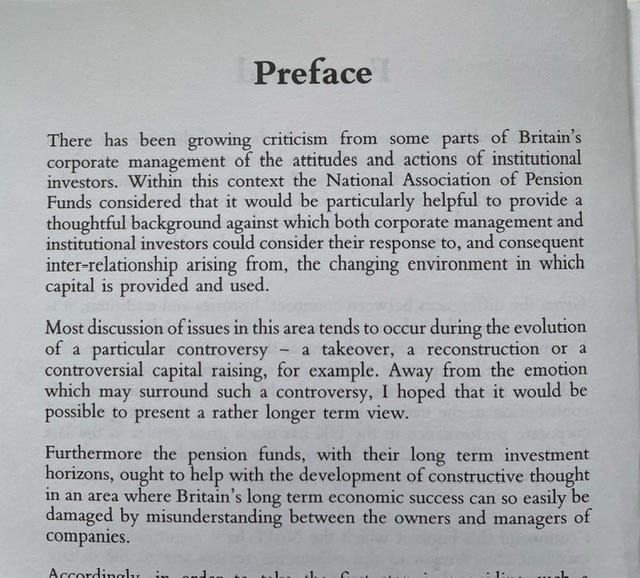
There is much discussion currently of the need to improve the relationship between publicly-listed companies and their shareholders. As such, I thought some readers would find the following commentary from a business leader and Conservative politician on the state of the relationship interesting:
Until their power was curbed, monopolistic representatives of working people - some trades union leaders - were not accountable to their millions of members and could cast their votes without consulting their wishes. That concentration of power was seriously damaging the economy and legislation was required to redress the imbalance between the trades unions and industrial management.
Today there is a concentration of capital power in the hands of relatively few institutional fund managers. While the fund managers may be given investment guidelines by their own boards or trustees, they are likely to have wide discretion. In effect, therefore, they probably have complete control in the disposition of the funds entrusted to them, and in the buying and selling of publicly quoted companies - they can cast the votes of millions of savers or pension fund beneficiaries without consulting their wishes. This too poses a threat to our future economic well-being…
A wedge is being driven between the providers of capital and its productive users; each seems to be living and operating in a different world with a different timescale, and this is extremely unhealthy for the national economy.
This comes from an essay entitled The Balance of Responsibilities by Sir Hector Laing, then chair of United Biscuits PLC and subsequently both a Conservative peer and a director of Exxon. The essay appears in Creative tension? a collection of essays on issues arising from the relationships between the management of public companies and institutional investors published by the National Association of Pension Funds (now the PLSA, of course) in 1990.1 That’s where the picture above comes from.
As outlined in my previous post on ESG metrics in pay, I’m interested in how ideas come to dominate in governance, and then give way. I hope the quotation above illustrates that we have been here before. In reality, the relationship between companies and investors has been characterised and understood in different ways over the years, including the question of ‘ownership’,2 and mainstream views were sometimes radically different from today. Another favourite example of mine is from another Conservative peer, Lord Eustace, in a speech in 1944:
The human association which in fact produces and distributes wealth, the association of workmen, managers, technicians and directors, is not an association recognised by the law. The association which the law does recognise — the association of shareholder-creditors and directors — is incapable of production or distribution and is not expected by the law to perform those functions. We have to give law to the real association, and to withdraw meaningless privilege from the imaginary one.
For the past few decades, the idea that public companies should be accountable / responsive to shareholders as a significant stakeholder has become established in numerous markets. But that isn’t to say that the nature of the relationship doesn’t face critical analysis and challenge.
In my experience in recent history commentary on this topic has cycled between concerns that (some) boards/companies are acting poorly and/or shareholders are failing to restrain/redirect them on the one hand, and fears that shareholders are too aggressive and/or short-termist and that discussions with them get in the way of really important work on the other.
In the first stage there has often been policy making, either to provide more information (enhanced disclosure requirements) or rights (particularly voting rights) to shareholders and more recently to more tightly define expectations of investors (Stewardship Code, fund labelling etc). This has undoubtedly increased the amount of compliance work required of both groups.
To me it feels like we’re in the second stage of the cycle, where boards complain that they are being treated unfairly. I’ve seen this happen before. For example, after the introduction of a shareholder vote on remuneration reports in the UK which took effect in 2002 there were even a couple of headlines about ‘peace talks’ between corporates and investors. And as the opening quote shows there had already been something similar in the late 80s/early 90s when the concern was more around short-term pressure from investors for results.
We can see this expression of corporate concern currently in at least a couple of areas: executive pay and listing rules. In both the threat of making the UK uncompetitive is invoked - we aren’t letting boards pay enough to get the right people, we’re putting too much clutter in the way of doing business, and we’re not letting founders retain control to pursue their entrepreneurial vision.
People in the financial sector who have never really been sold on the notion of accountability to shareholders / second-guessing boards (depending on your perspective) are ears open. More generally I think there is a reasonably widespread view that a lot of the asks investors make of companies as part of their stewardship activity do not have a clear enough link to operational and financial performance.
As a result currently there is a powerful coalition, encompassing representatives of business, the investment community and politics, in favour of cooling things down and this seems to have already had an impact on the orientation of some institutions. And I am not convinced (given the lack of noise from Labour on listing rules, for example) that a change of government would significantly alter this as things stand.
There are a few points to consider:
Given that the current status quo includes significant regulatory and reporting requirements, is it possible that we might see some rollback? At the moment I think this is unlikely but a question lots of people ask is “who is actually reading all these reports?”.
I would also note that it was a Labour government that backtracked on the requirement to produce an Operating and Financial Review. There might be support for further disclosure requirements in some areas, but I would not put the probability of Labour wanting to do something deregulatory at zero.
We are currently focusing on the downsides of reporting and investor protections, and perhaps forgetting why they are there (Chesterton’s fence again). Dual class shares sound OK if you are sure that the person that has them is going to exercised unchecked power responsibly.
One of the companies I was involved in engaging a decade or so back was News Corp, in response to extensive illegal activity that cost the company millions to address. We could not get any board accountability there, precisely because of the share structure. It’s hardly a unique example and some companies that are not strangers to controversy also have this structure.
What happens the next time something goes wrong? I do wonder how different the nature of this discussion would be if the scandals at FTSE100 constituent NMC Health and FTSE250 constituent Finablr had not occurred during the pandemic. But things being as they are it is only a matter of time before something significant goes wrong at a UK-listed company where governance and/or shareholder rights are below standard. What will be the reaction then?
Thinking back to the Sir Hector Laing comments, if the relationship between companies and investors changes, what does this mean for countervailing power more widely? Might new sources (re)emerge?
My general view is always that there is no settled state in any of this. Interests have been balanced differently in the past and will be again in future. Whilst I’m not a fan of the rather teleological notion of ‘progress’, I very much like the line from Nye Bevan: “[P]rogress is not the elimination of struggle but a change in its terms.” Like any clash between interests, this is a game that is played out repeatedly, and the balance only settles in a certain position temporarily. No-one should expect that there is an endpoint of any kind, let alone one that is conflict free.
One of the other old books of this type that I have on my bookshelves is Short-termism On Trial by Paul Marsh, which was commissioned by the Institutional Fund Managers Association as a riposte to the claim they were putting companies under short-term pressure for results. Corporates thought investors were getting it wrong at that point by being too interested in returns.
I have 12,000 words I wrote on this topic somewhere, but that’s for another day.