
Passive power
Tracking indexing and common ownership risk disclosure

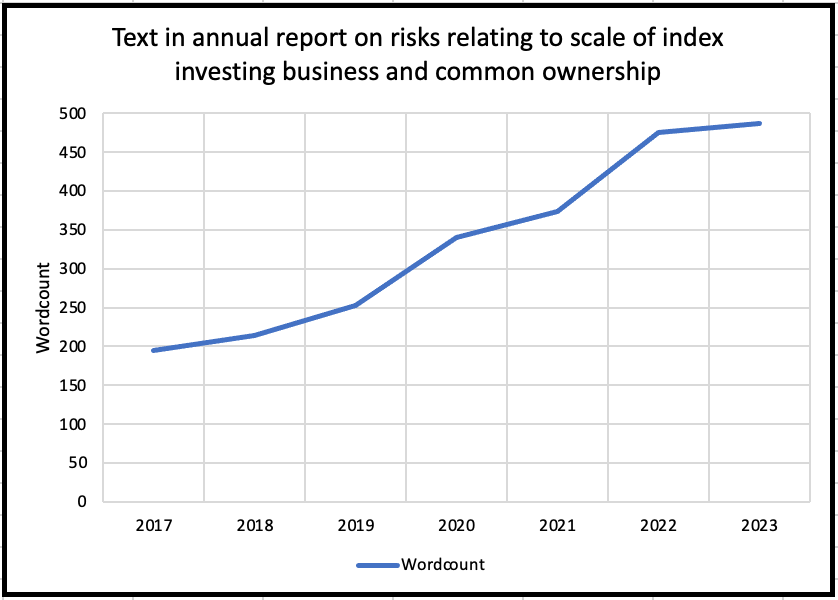
It’s that time of the year again when annual reports are popping up constantly. This is also the time I like to look through risk disclosures. Usually I’m looking for workforce-related risks, but in recent years I also started paying attention to competition-related disclosures by certain asset managers.
In particular, I’ve been following what A Very Large Indexer discloses about risks relating to the scale of indexing and to common ownership - where they have positions in multiple competitor firms. Common ownership has been memorably described as the ‘evil twin’ of universal ownership, and if you think the latter has real explanatory power you really should think about the former.
I am aware that some asset managers have been pushing back against the common ownership theory so the extent to which they identify such issues as a risk ought to give a potential indication of how seriously it is taken. So a couple of years back I went back through all the annual reports in which the particular manager has disclosed this as a risk factor - starting in 2017 - and did a simple word count. As you can see it’s been creeping up year after year. The latest annual report, which came out recently, shows a further, very marginal increase.
But it’s not just about the word length clearly, the content is valuable too. A couple of times it has alerted me to regulatory or policy initiatives that I was not aware of that I subsequently looked into. This year the disclosure includes the following: “In 2023, the UK Competition & Markets Authority (“CMA”) established a new economic research unit which identified common ownership as a potential research topic.”
I know the CMA has been looking into common ownership, as it featured in the most recent State of Competition report, but this disclosure prompted me to have more of a poke around and led me to the CMA Economic Research Strategy. This is exactly the kind of thing I like - both an indication of regulatory interest areas and as it includes a list of relevant papers in each of the areas.
Common ownership is in there, obviously:
Corporate ownership and firm organisation
4.15 Corporate ownership structures and the organisation of the firm are active areas of research both in antitrust economics and for wider productivity concerns. Within competition economics, common ownership and vertical mergers have received increasing attention. More widely, managerial incentives, organisational practices and the boundaries of the firm may be behind major trends for productivity, wages, and investment. Relevant research topics include:
The importance and impact of common ownership and interlocking directorates
Efficiency and anticompetitive explanations of vertical mergers
Outsourcing, organisational practices and within versus between-firm wage inequality
(That last bullet looks interesting.)
But also…
Supply chains, monopsony and labour markets
4.11 Traditionally, competition authorities have focused on horizontal product market competition. Market structure may also influence supply chains, including their resilience in the face of unanticipated shocks. Market power may also take the form of monopsony in labour or other input markets, distorting employment and investment choices and harming consumers welfare. Relevant research topics include:
Supply chain structure, monopsony power in input markets and resilience to shocks
Measuring labour markets, measuring search frictions, and estimating labour market power
Theoretical and empirical research on the role of labour unions and other institutions
And as we have seen recently the CMA has indeed pursued labour market power as an area of interest, so will we see something similar in relation to common ownership? If so expect that risk disclosure to increase in length again next year.