
Passive aggression
Charts and quotes on concentration problems and general indexation vexation

Continuing to poke around the issues of passive management, concentration and common ownership, I remembered that the Investment Association’s annual survey includes a section on industry concentration. This includes an HHI score based on managers’ AUM shares. The IA has been producing this data for many years, so below are the figures for the decade to 2021. (Unfortunately no actual data, just a chart, in the 2014/2015 survey).
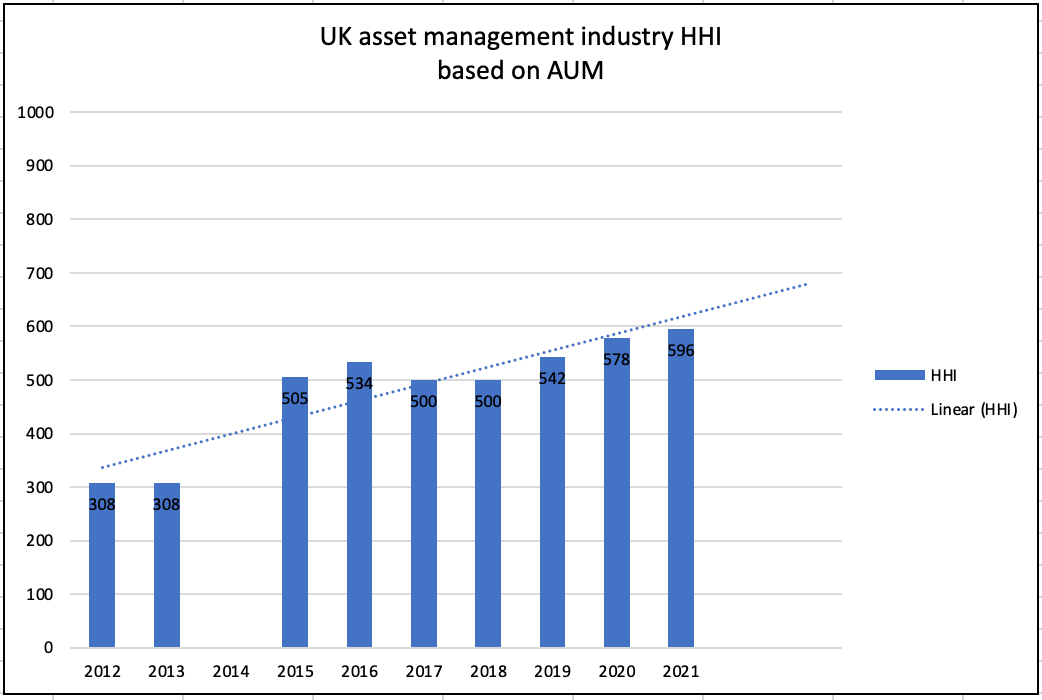
A couple of takeaways - concentration increases significantly during the period but is also below the level at which a competition regulator might have concerns.
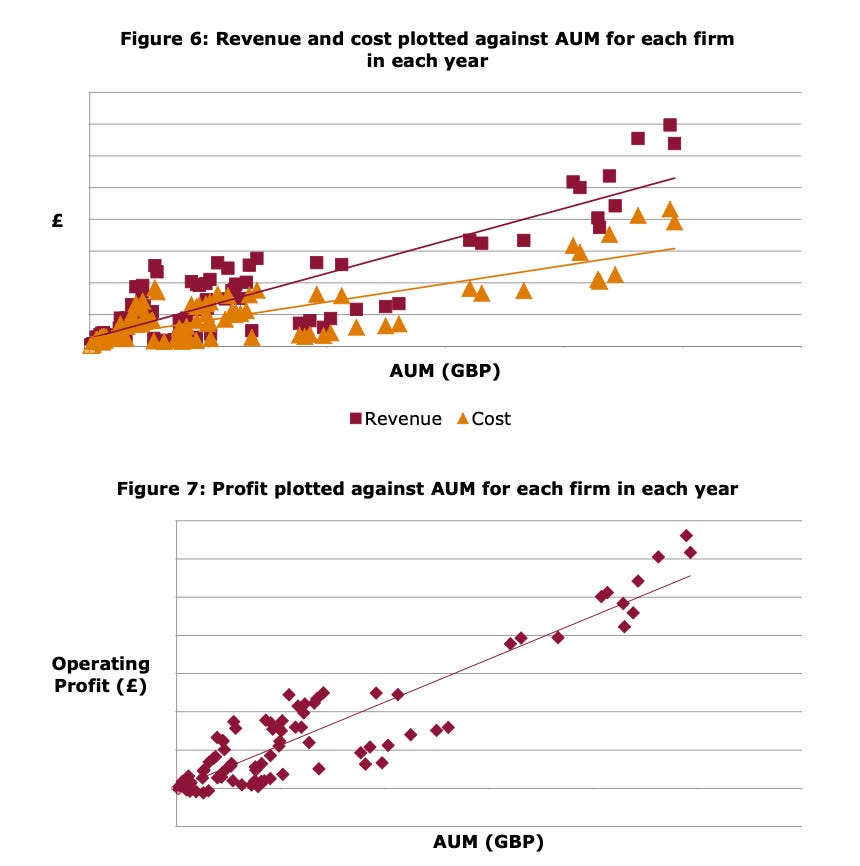
The IA uses AUM as a proxy for market share, saying this is correlated with revenues. I think that sounds reasonable, though would be interested to see an analysis of market concentration based on revenues and profits. For some context here are some charts on asset manager profitably and AUM from the FCA’s Asset Management Market Study. It’s obviously a few years old but I assume not much has changed.
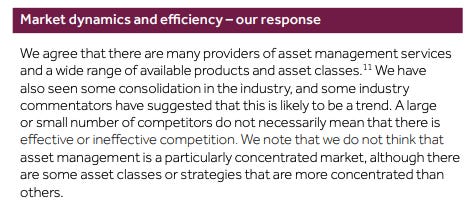
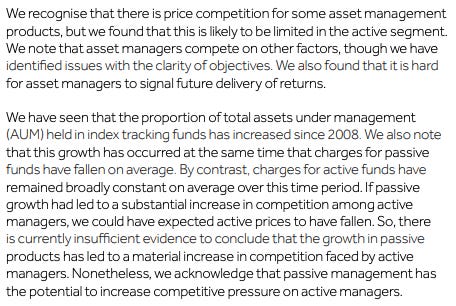
I also had a random thought as to whether active and passive management should be split out separately in market concentration analysis. Notably the FCA did touch on the different market dynamics of active and passive, if not concentration specifically.
Relatedly, I went back to look at the discussion of common ownership in last year’s State of Competition report issued by the CMA. There’s a very interesting section where the CMA calculated 'modified HHI’ figures taking account of common ownership.
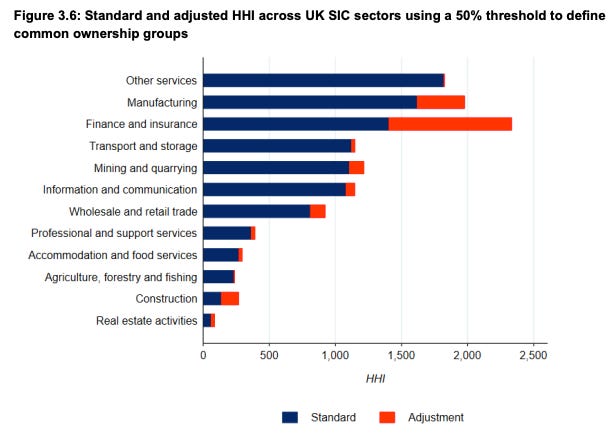
It’s worth reading the CMA analysis in full as the calculation of common ownership is not straightforward and is obviously doing a lot of work here. In addition the use of SIC codes means a lot is lumped in together under ‘finance and insurance’. I imagine even the unadjusted figure has a lot to do with banking. Still, the fact that common ownership potentially makes such a significant difference to the CMA’s thinking about market concentration is interesting.
Final chart, again from the 2016 FCA study, puts the industry’s operating margins in context.
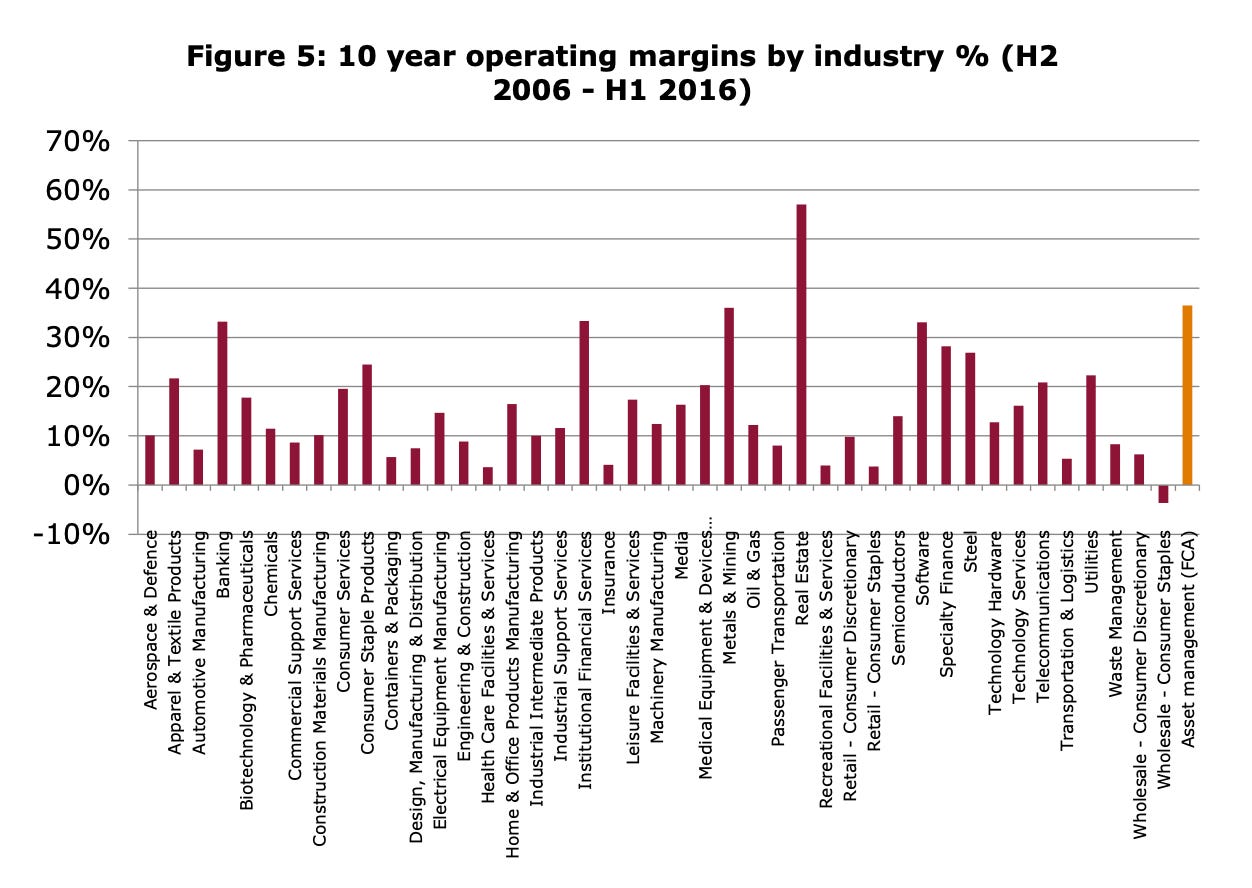
It would be ironic if a competition regulator’s assessment of market concentration in asset management was affected by the nature of the business itself.
Flipping to policy interest in passive management, I recently read and enjoyed The Problem of 12 by John Coates. It’s a very short book, and I know the turf already, but I still found it added something. Passive management is only one of the two problems of concentration he identifies (the other is private equity) and he brings a bit of nuance to the topic. For example, he rightly stresses that passive management has in general been a great innovation for the public, so we need to guard against overreaction.
Nonetheless he is also concerned by what it means in practice:
How do index funds exercise political influence? They mostly do so indirectly, as owners of large blocks of corporate shares. Because they own an increasing share of all large public companies, they influence much of the economy. They can use their votes as shareholders to affect mergers, board elections, and the outcome of shareholder resolutions. They can use their power to ensure that corporations' top executives will answer their calls, take meetings with them, and engage with them on a range of issues. They work to put policy issues on the public agenda, to influence how regulations are shaped, and to respond to company-specific choices and crises. By influencing companies, they influence the economy, and the way that elected officials govern. Even if Congress or the SEC or some other agency does not mandate that companies behave in a certain way, index funds can pressure companies to act that way. Corporate governance can be--and increasingly has become-a substitute for ordinary political governance.
And he also covers a favourite topic of mine, and a surprisingly unscrutinised one, which is stewardship activity around M&A.
When management proposes a merger requiring a shareholder vote, or when another shareholder-often a hedge fund-proposes a sale, seeks to install individuals on the board, or starts a full-blown proxy contest for control of the company - an index fund's influence grows significantly. As with ordinary shareholder proposals, index fund positions in a disputed merger vote or control contest are typically pivotal if the top index funds take similar position.
BlackRock reported having voted for 31 percent of dissident proposals in the year ended July 2019, up from 19 percent in 2017. Vanguard reported having participated in over 7,500 merger votes in each of 2018 and 2019, voting no on more than 600 mergers in those two years. While that number is a relatively small fraction of the total number of merger votes, it is large in absolute terms, and large enough to create a meaningful deterrent for managers who are planning a merger proposal, as the costs to both companies and managers of a failed merger vote are significant. State Street reported that 6 percent of their engagements concerned proxy contests, mergers, and acquisitions in the year ended July 2019.
It is true that the direct component of this influence is contingent. For an index fund to exercise actual power through this channel, some other actor has to do something first: an active hedge fund or other activist shareholder needs to propose a resolution or to contest board seats, as in the ExxonMobil fight, or the management of a public company must propose a merger or other event requiring a vote. Nonetheless, managers know these events happen with regularity, and know that index funds will be pivotal to their outcomes.
Specifically, when an index fund engages with a public company, the company's CEO knows there is a meaningful chance that a contest or an activist campaign or a merger will occur before that CEO's tenure is over. CEOs listen with a keen ear in such moments. They know that when shareholders vote, index funds are watching whether the companies do what the shareholders want. Reputations and relationships built in engagements influence future votes.
The bottom line of this review of how index fund advisors use their power to control public companies is neither that they exercise pure control nor that they are passive, in the manner of investors in Berle and Means-style companies in the twentieth century. Rather than blindly choosing stocks in their index and then ignoring them, index fund managers have, and are increasingly using, multiple channels to influence public companies of all sizes and kinds. Their views on governance issues, their opinions of CEOs, their desires for change at particular companies, their response to and evaluations of proposals from hedge fund activists-all of these matter intensely to the way the core institutions in the US economy are operating.
This, to me, is pretty uncontroversial in terms of the mechanics and I also agree with Coates that it does raise some tricky questions.
Passive managers do not acquire shares because they like the issuers, but because they are in a given index. Nor do they win or lose business on the basis of the performance of the companies in which they hold shares. So they have an influence over companies that they did not deliberately seek and no requirement to seek to improve the performance of those companies.
What is more, if the client has put money with a passive manager because they do not believe active managers can outperform by picking companies, it seems a stretch to think they will believe any manager can pick the ‘right’ way to steward an investee company.
And if the response to the failure of stock-pickers to outperform is to stop paying for stock-picking, why do it for other activities with unclear outcomes? For example, if M&A activity generally fails to deliver value, and it’s hard to tell which deals will or won’t do so - and thus which M&A proposals to vote to support - why not stop supporting them? Any of them. Like trying to pick stocks, supporting M&A activity might be a pointless portfolio-level activity that simply incurs extra costs that could be shed. No need to analyse any companies, just don’t support any of the deals that come forward.
Maybe the same goes for executive pay. Paying for executive talent may or may not work at a stock-specific level, but executive pay inflation (generated if everyone is trying to pay ‘top quartile’) might simply be a portfolio-level cost that could be shed. Funnily enough BlackRock acknowledged this fallacy of composition type problem in its response to a BIS (as in the government department name before BEIS) consultation way back in 2011:
One of the difficulties we face as investors is that we (rightly) assess a company’s arguments for pay changes or increases in light of that company’s circumstances. Generally, companies do present strong arguments for the changes they wish to make. But our assessment tends not to take into account the impact it will have on the trend overall.
So why support any of it?
I know the reality is more complicated. I also know that one retort could be that equally one could argue passive managers should simply support everything rather than seek to second guess management.
The big point is that any position adopted is rather arbitrary and out of step with the rationale for going passive in the first place. Unfortunately, no position will satisfy everyone either. Coates has a sophisticated approach: he says this is a dilemma to be managed rather than a problem to be solved. He advocates more disclosure, particularly in relation to voting and engagement activity, and how policy positions are arrived at.
Personally I think this is unlikely to achieve much. We have a lot of this type of information already and yet political challenges to the big passive managers have emerged. (Indeed some of these challenges make use of public disclosures.)
My own underwhelming opinion is that we are only starting to work through the sticky issues posed by passive management’s dominance - a fact in the asset management industry and in corporate governance that will only grow in importance for the forseeable future. My only small contribution is a growing conviction that we must treat passive management as a fundamentally different thing to its active counterpart when thinking about policy responses.