
Looking back on Covid
Did care workers bear the brunt?

Over the past few months, quite a few people I know have had Covid again. It’s still an unpleasant and debilitating experience. However, since the deployment of vaccines it is far less of a threat, and most of us therefore treat it less seriously.
I think we have started to forget just how dangerous it was to some groups. For the elderly, infirm and immunocompromised it was was a very real risk. All of us with elderly parents or family members with health issues were acutely aware of this at the time.
Covid was also an occupational health risk for certain groups of workers. While the pandemic was raging, I spent quite a bit of time with colleagues looking at the spread of Covid in food processing. There is still a useful job to be done reviewing exactly what happened there, and there were some interesting pieces of research carried out that probably deserve re-visting.
It is clear that amongst the occupational groups most at risk were health and care workers. As a very basic proxy for this during the pandemic I regularly looked at RIDDOR report data disclosed by the HSE. This is flawed for a number of reasons. For one, there was a lot of confusion over the extent to which Covid cases were reportable, particularly if it was unclear if Covid was contracted at work. I also think public sector employers were more likely to report cases.
Nonetheless it is something to work with. Here are the HSE’s stats for 2 years from early April 2020.
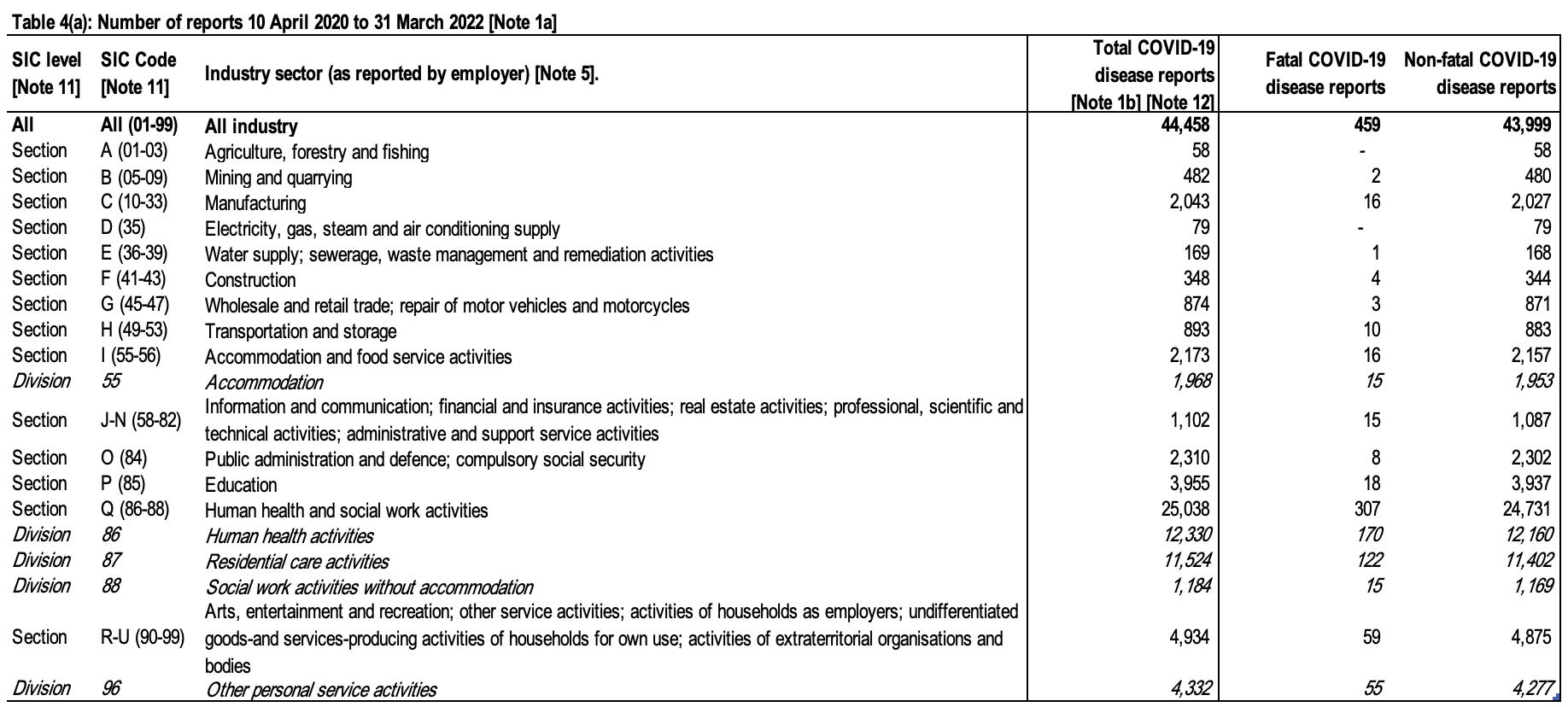
Two obvious points: of all workplace Covid cases reported under RIDDOR more than half (56%) related to health and care workers; and of all workplace Covid fatalities two thirds (67%) came from those two groups. Even allowing for private sector under-reporting I am doubtful that this greatly overstates the risks to these two groups. The proportion of fatalities as a proportion of total Covid cases reported under RIDDOR is a bit higher for health workers (1.38%) than care workers (1.06%).
We know why healthcare workers might be more at risk - there were lots of people with Covid in hospitals during the period. But they should have also had access to the best PPE equipment. Care workers, though, are perhaps more surprising. It might even be that they were more at risk.
The following comes from ONS analysis (the original table is a long/wide one so have cut into three chunks). The data relate to people in England and Wales of working age (20-64) from 9 March 2020 to 28 February 2022.

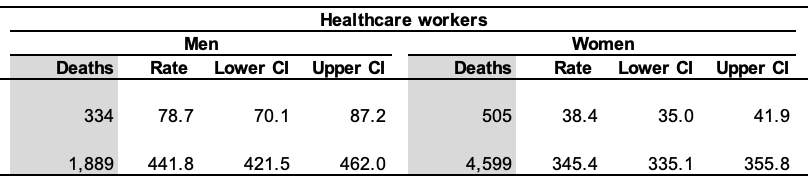
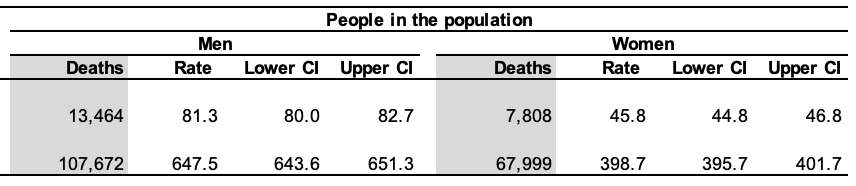
A couple of quick points. First, assuming ONS is using the same SIC categories as HSE, overall deaths are more than double the RIDDOR-reportable Covid fatalities for a broadly similar period. That gives us a very rough view of the extent to which Covid fatalities amongst these workers may have resulted from work. Second, healthcare looks a lot safer than social care.
I do wonder if this in part reflects significant differences in the nature of employment. Presumably NHS staff were more likely to be in large workplaces where regulations were more likely to be enforced, by management or union reps. It must have been much easier to raise concerns if rules were not being followed. NHS staff are also on standard employment contracts, so calling in sick does not result in loss of pay. In contrast as we know many care workers do not have guaranteed hours and are on or close to minimum wage. Missing a shift can mean lost income.
This is obviously speculative, but there seem to me to be issues worth further scrutiny here, and it points to a wider challenge. There are lots of reasons to be concerned about workplace standards in care. In addition to safety, low pay and insecure hours, we are also seeing rocketing claims of modern slavery, something I may return to in a future post. Looking at the UK, investors might have exposure to the sector through both private equity and property funds. It is surely an area to prioritise.