
Large managers and small wages

Indexers and banks
There was an interesting piece in the FT last week on resistance by BlackRock to action by the Federal Deposit Insurance Corporation to address the influence of large shareholders in US listed banks. From the reporting of it, it seems this intervention is seeking to limit their influence once they achieve a certain level of share-ownership:
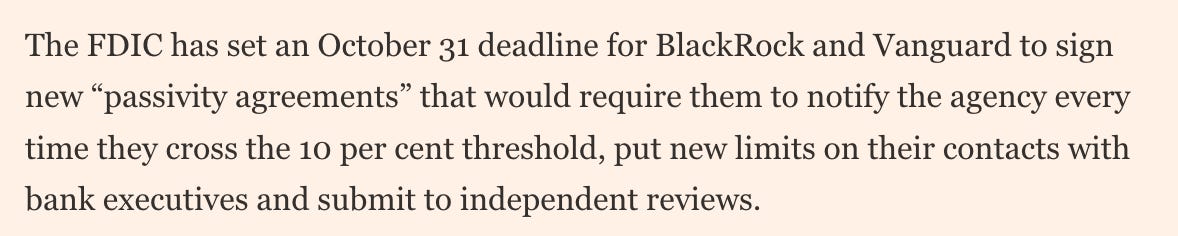
This intervention is obviously linked to the ever-increasing size of the big passive managers. What’s interesting is that the FDIC’s view is that the influence of these investors needs to be curbed.
BlackRock in turn argues that it does not seek to “direct a company’s strategy or its implementation” through its stewardship activity:
BlackRock’s fiduciary responsibilities to our clients include making proxy voting determinations, on behalf of clients who have delegated voting authority to us, in a manner that is consistent with their investment objectives. As part of these fiduciary responsibilities, BlackRock’s investment stewardship team encourages sound corporate governance practices at portfolio companies that, in its experience, protect investors’ interests and long-term financial value creation. The stewardship team does this through engagement with companies and, for those clients that have given BlackRock voting authority, through voting proxies on their behalf. As one of many minority shareholders, Blackrock cannot – and does not try to – direct a company’s strategy or its implementation.
This is getting into interesting territory. I think that, because of concerns about their scale, some of the big managers are trying to make it very clear to certain parties that they are not seeking to (significantly) influence portfolio companies. From a stewardship perspective one would generally think that an increasing scale of voting influence entails increasing responsibilities. But the regulator in this case seems to want to reduce the influence of at least some investors and those investors in response are saying this isn’t required because they are generally hands-off.
There are numerous areas of finance where the scale of indexers is starting to crop up as a challenge and, currently, it does not look like anyone is clear about what to do about it. The FDIC seems to think it’s better to reduce their power. If the response of the largest managers is “don’t worry, we won’t try and steer the ship” that has further implications. If the largest shareholder in hundreds of companies signals its intention to stay out of things most of the time, it would be rational for the leadership of those companies to conclude that accountability to shareholders is weaker than expected.
As I’ve argued before, this also poses a challenge for those who want to push the largest managers (because that’s where the most potential power is) to more robust positions on ESG issues. It’s clear that (for now?) that isn’t going to happen and the managers are themselves signalling a more ‘hands off’ stance. Do you keep trying to push that block of capital / votes in a certain direction, try and dissipate it or something else?
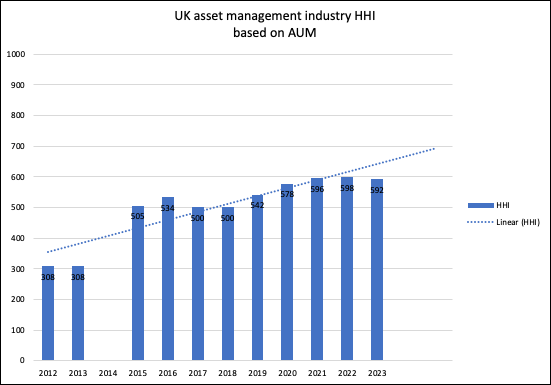
A final related snippet from the UK, where issues about scale and common ownership are also starting to appear in various places, including the work of the CMA. The Investment Association has been tracking market concentration in asset management using HHI for over a decade. The latest IA survey came out a couple of weeks back and it looks like concentration has plateaued. A poor quality chart using the IA’s data below…
Wages and investors
Tom Gosling recently posted a link to his analysis from last year of the Share Action resolution on the Living Wage filed at Sainsbury’s. This is a really thoughtful and well-argued take on the topic and there is much in it I agree with, though I did not reach the same conclusions.
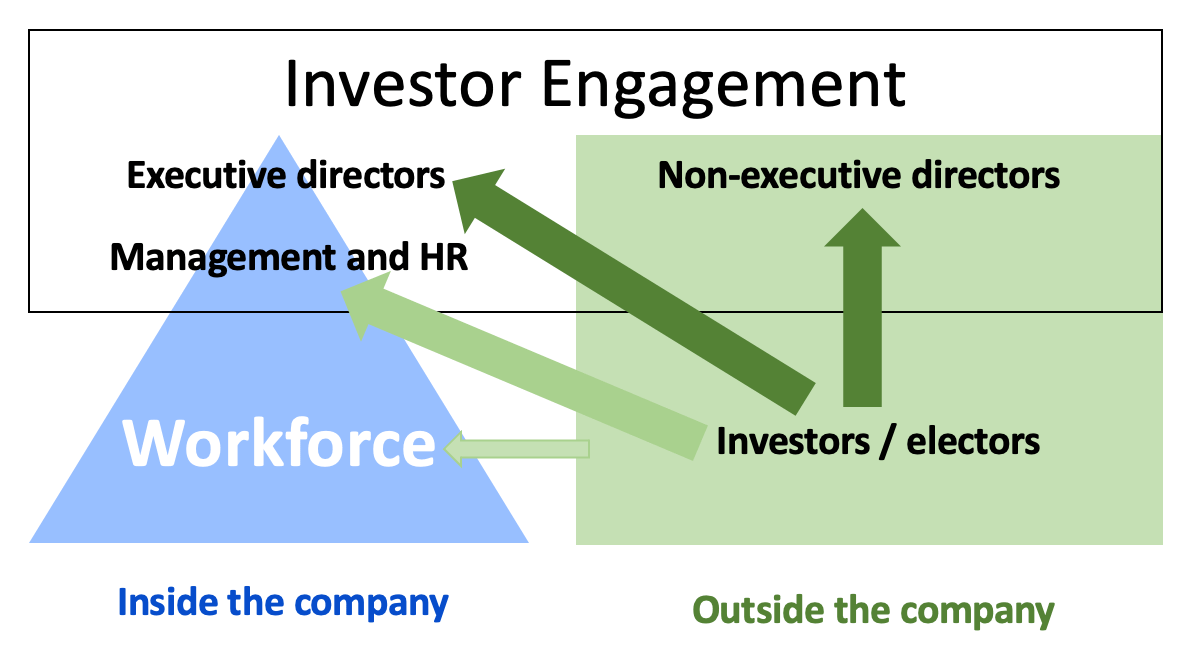
Because it is a thoughtful piece, it did provoke a few thoughts. First off, at a general level, it did make me reflect how often in discussions of this type the workforce within companies does not seem to be perceived as an agent. The achievement, or not, of the Living Wage, or any other improvement in their terms and conditions, is something that is determined by others. In the corporate governance / investor stewardship world we typically focus on the relationship between ‘companies’ and ‘investors’.
But when you look at a company from a labour relations perspective - and particularly when thinking about wages levels - the action occurs within the company and the two principal actors are also internal to it. Traditionally, improvements in wages within many companies have been achieved through collective bargaining between management and workforce representatives. While this is less common than it used to be, it’s still an important factor in some sectors, so it’s a little odd (to my ears) to hear no mention of the role of the workforce itself when discussing wage outcomes.
I recognise Tom’s analysis is largely focused on why the specific proposal did not merit support in his view, but it does lead onto the following claim:
System-wide issues such as the appropriate minimum wage levels run into many level-playing-field problems relating to competitiveness. In such cases, governments are generally best suited to address the issue of inequality directly through minimum wages, progressive taxation, and benefits—and, in the longer term, through policies on education, health, and housing.
I’m not sure this is necessarily true for specific groups of workers at any one time. Governments by nature of their political complexion may be more or less concerned about wage levels and/or inequality. Even if they want to act, this may not achieve change quickly, and policy can be reversed after a change in government. And, in respect to wages, they are only setting the minimum whereas the real Living Wage is above it. It is still the case for many workers in the UK that improvements in wages will be achieved most effectively by action by representatives from within their own ranks. We have just seen this in practice in numerous workplaces in response to high inflation. Neither the government nor investors were part of the process in most cases (obviously the government has a role when the state is the employer).
From a labour relations perspective the balance of power between management and workforce is central, and personally I think this has to be part of the story, even when we’re talking about other parties’ actions that relate to wages.
Here’s another place where I might take a different view to Tom:
No other UK supermarket is a Living Wage Employer, and this group includes both public and private companies, and those owned by families as well as by private equity firms. How likely is it that all of these companies and management teams are missing an easy win-win from increasing wages to increase long-run profits and value?
This is a straightforward and powerful point. This is what I would call the ‘implicit business case’. In the same way that the proponents sought to make a business case for Living Wage accreditation, the prevailing wage levels implicitly embody a business case - because the employers think this is the best level to set pay in order to achieve their (possibly competing) business objectives.
Perhaps the labour market for retail workers is optimised and we have reached an equilibrium that balances supply and demand and all the factors that drive them. However, is there potentially more than one equilibrium that retailers could settle into in respect of wages that would be acceptable to all? Personally I would not rule out the possibility. Asserting that the current ‘price’ paid in retail wages must be about correct because none of the market participants seems willing to pay more is sorta the efficient markets hypothesis applied to labour.
Just as the EMH is quite a good rule of thumb, and should make us humbler when thinking we’ve spotted a new opportunity, it’s a widely held view that even financial markets can get out of whack for extended periods. The current settlement in retail sector wages reflects multiple factors - including the market power of supermarkets. It might not be ‘easy’ to get there, but there might be a workable model of the retail market that involves higher wages, but no incentive for employers to break out of the status quo. As I say, I wouldn’t rule it out.
Tom also makes the point that a company that went first in terms of Living Wage accreditation could leave itself exposed versus its competitors, including those that are privately owned:
If the resolution is successful, that could lead to an industry-wide change in practices. But in what is at least an equally plausible outcome, it could simply make Sainsbury's uncompetitive, leading to loss of market share to companies not adopting the Living Wage policy. Also worth noting is the possibility that, even if investors were successful at passing resolutions at all the listed supermarkets, the steadily growing proportion of the UK market subject to private control, including Aldi, Asda, Lidl, and Morrisons, would use their lower wages to accelerate their growth in market share.
These points have logic from a corporate governance or investor stewardship perspective, but less so from a labour relations one. On the competition point, the logic of ‘pattern bargaining’ basically looks at the issue completely the other way around: getting a good wage increase out of one employer provides a platform for workers in similar firms to push for the same. Whether or not they are able to is again a question of power. But, as an example, it’s roughly what has happened in the big US automakers in recent history.
And the listed/private ownership split is, if not completely irrelevant, not much of a complicating factor either. Workers within a sector negotiate with their employer regardless of how the company is owned. To demonstrate this, I was told by private sector employers that they were watching certain public sector pay settlements as a factor they would need to take into account in their own pay round.
Again, one could argue that these are side issues because this resolution is being analysed from the perspective of investor stewardship. In turn it’s important to remember that these are not sealed areas of contestation, they have impacts outside whether we include them in our analysis or not. If the Sainsbury’s resolution had passed, or some compromise position been reached, it might have strengthened the case for the workforce in other supermarkets to seek higher wages. Investors taking a vocal stance against the resolution may also have had an impact, since it potentially strengthened the hand of employers. (This last point was a clincher for me when thinking about the dynamics of the vote and one reason why ultimately I would come down on the other side of this one to Tom.)
Having made the above points, I want to emphasise that I really like Tom’s analysis, agree with much of it and think it is a great example of clear and polite argument. I also think the suggestion of how resolutions of this type might be improved is both helpful and the sort of positive approach we need when tackling these kinds of topics.
Much of the investor engagement work I’ve been involved with around workforce topics has involved getting the framework right. I would like to see more engagement where investors clearly support the right of workers to organise and collectively bargain but then (basically) get out of the way. As long as it is a ‘fair fight’ we should err on the side of management and workforce being able to work out between them what is appropriate. But a fair fight would entail no interference - for example the use by companies of third-party union avoidance advisers.
‘Where’ is the company?
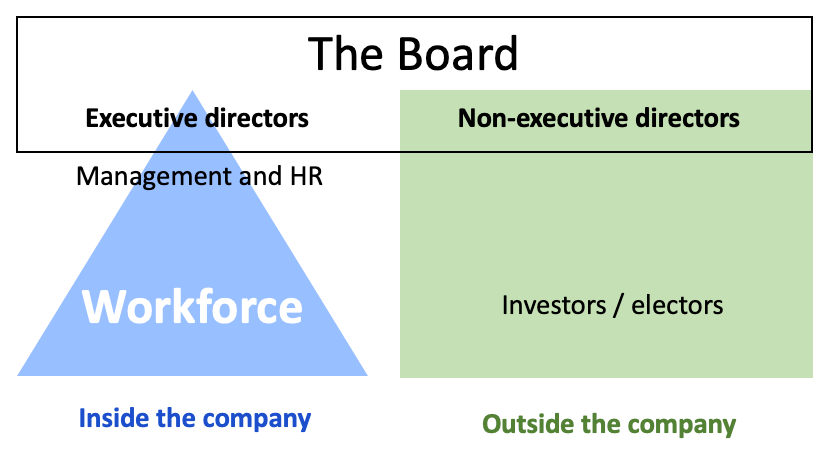
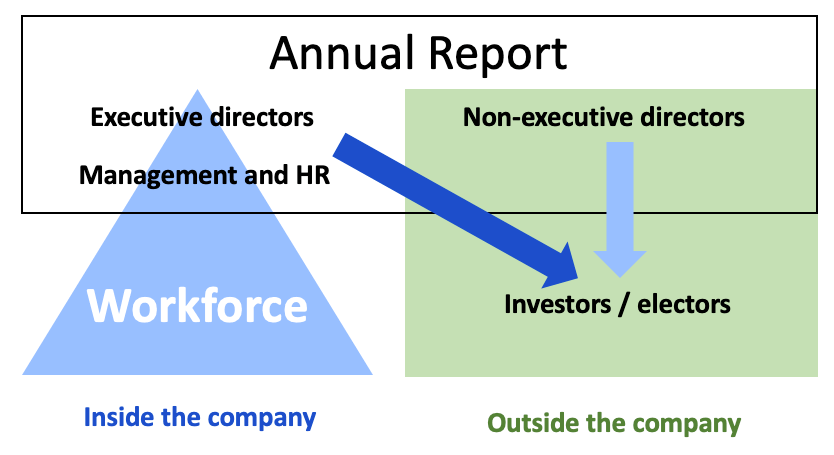
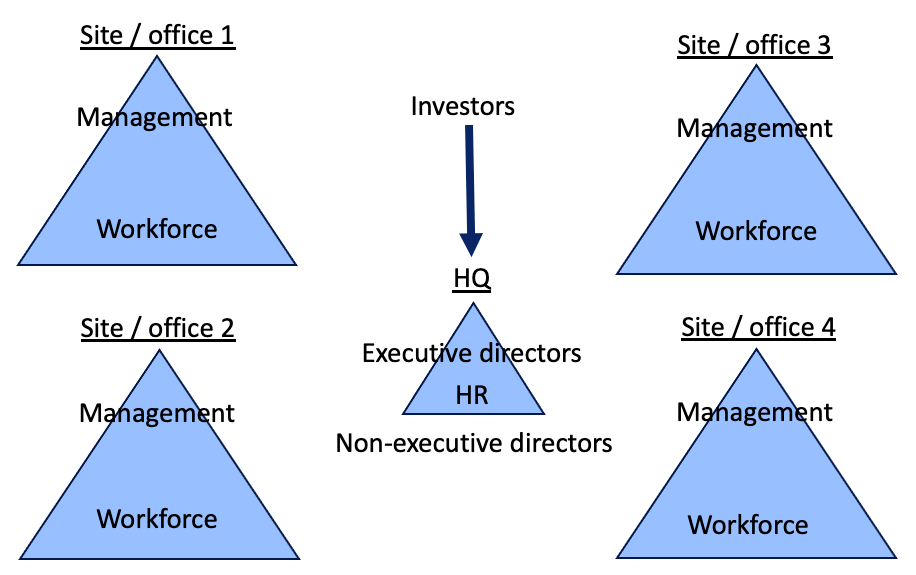
To finish up here are some snips from a slide deck I’ve been working on that tries to get at the question of ‘where’ the company is and how investors relate to it. This was driven by my sense that discussions about ‘the company’ and policy and engagement that flows from it can focus on a partial view of the organisation at the centre. It is a bit of a work in progress.
Another great post, Tom. Especially like your analysis of the living wage resolution. Posts like this make it SO much easier to stay off Twitter