
Governance versus growth

The government’s decision to scrap the Audit Reform and Corporate Governance Bill, announced last week, is not an isolated retreat. It is part of an observable broader shift away from an approach to governance based on a conception of accountability to a growth-centred model in which transaction efficiency matters more than countervailing power. What is striking is not just what is being removed, but that nothing is being put in its place.
The announcement is worth reading to understand the government’s thinking:
Firstly, our priority is to promote economic growth and reduce administrative burdens. While the planned reforms would be beneficial, some would increase costs on business, and it would not be right to prioritise those over more deregulatory measures. We intend to focus instead on the simplification and modernisation of corporate reporting. We want to make the UK’s reporting regime the most streamlined and proportionate in the world and will launch an ambitious consultation this year to co-design these changes with companies and investors.
Secondly, the need for major reform is less pressing than it was. A great deal of progress has been made since the collapse of Carillion in 2018. We have seen considerable improvement in the quality of audit regulation, and of audit itself, and I am committed to continued support of the measures taken by the Financial Reporting Council and the audit sector to achieve these improvements. My officials and I continue to work closely with the Financial Reporting Council to make the audit market work better, minimise the administrative burden of regulation and to support growth.
Thirdly, the Government is pursuing an ambitious legislative programme and parliamentary time is limited. We respect the time and resources of our stakeholders and therefore do not want to consult to seek further input on policies that are not likely to progress in the near future. I remain extremely grateful for the ongoing interest and engagement that we have had from businesses and other stakeholders, and from the Committee, in this work.
I leave the second argument, about progress since Carillion, to others who know the audit world to take on. The only minor point I would make is that the chances of an accounting scandal involving a PLC in the next three years are not zero. If one does occur this might become a weak point for the government. The final argument, about limited parliamentary time to tackle various challenges, is not unreasonable but obviously could be applied to anything. What this really shows is that reform in this area is a low priority for the government.
So it’s the first point that matters the most and is very much in line with the government’s approach in other areas. Anything that is seen, or can be characterised, as getting in the way of economic growth is a target. The overarching mindset of various parts of government seems to be that burdens on business are barriers to growth must be tackled.
This is not the end of the line. Consider another sentence in the announcement: “We intend to focus instead on the simplification and modernisation of corporate reporting”. I think most people are a bit underwhelmed by the results of ‘getting companies and investors to disclose more’ as a mechanism for change in any case, but it doesn’t look like reporting enhancements are going to be on the table any time soon. Elsewhere this week the Government also referenced its intentions to move ahead with plans for allowing virtual AGMs.
Obviously this follows changes to the Stewardship Code, listing rules, the decision to bin the Investment Association’s register of high shareholder dissent and public disclosure of short positions being scrapped. There is a clear thread running through all of this.
It’s kind of the mirror image of the thread that connected the Company Law Review, the introduction of shareholder votes on remuneration, annual elections or directors, disclosure of voting records, the Stewardship Code and so on. That set of reforms was built around a conception of the need for public companies in particular to be more accountable to their investors.
This was at various times argued in terms of promoting economic performance (of companies), addressing under-investment, avoidance of impropriety, tackling corporate excess and to some extent promoting accountability for management of environmental and social factors. As a set of reforms it hung together conceptually.
In place of a reasonably coherent model of what governance is about, underpinned by multiple objectives, the government now has a single organising goal: improving aggregate economic growth. Regulatory and deregulatory interventions alike are required to justify themselves primarily in those terms.
Unfortunately for those defending the status quo or looking to go further, there are a lot of voices out there with gripes about standards and regulation who will (fairly or otherwise) present elements of the existing settlement as ‘barriers’ to growth.
It’s important to consider all this in good faith. The government’s growth objective has been very clear right from day one. The government likely considers that the UK makes a lot of money out of business services, including those relating to business formation and transformation. Anything that gets in the way of that, whether a less permissive takeover regime, more reporting requirements, listing rules or whatever, looks like a problem.
Similarly, one should not defend the status quo, or indeed planned reforms, for the sake of it. For those of us who work at the boundary where labour meets capital, the benefits for workers from the wave of corporate governance and stewardship reforms introduced from the 1990s onwards look rather meagre. As I’ve written before, this means it has not created large constituency who feel much is at stake now that settlement is under threat. I suspect this partially explains where we are.
As someone on the left side of politics, I’m not sure what a left-of-centre position on audit reform looks like, or even if there is any need for one. But what is interesting is that there doesn’t seem to be any kind of programme (or thinking) along these lines in the current government.
Bear in mind that the 1990s iteration that most of us have been working with, much of it brought in under the previous Labour government, itself represented a major accommodation with shareholder-centric governance. Despite Blair’s brief flirtation with ‘stakeholder capitalism’ this set of reforms strengthened the hand of capital, in the belief the ‘enlightened shareholder value’ would deliver for everyone. But there was a clear overall conception which one could easily trace back to core governance concepts (as contestable as these are) like separation of ownership and control, agency theory and so.
The current Labour government clearly does not have a set of connecting ideas guiding its policy interventions in the same way. If we boil this right down, where it once had a theory, it now has a priority. This brings clarity of purpose but it can risks losing a lot (ironically a little reminiscent of businesses fixating on shareholder value as an operational objective).
Its generalised approach embodies a view that there are numerous barriers to growth (regulatory/disclosure requirements on business and finance) that need to be removed. This suggests the government has inherited a governance regime that it doesn’t really believe in, and doesn’t have a set of significant internal or external stakeholders that are pressuring it to retain it.
If we think that corporate governance and stewardship are just about economic performance (which incidentally is broadly the position some are arguing is best to take in the face of the anti-ESG wave) then this doesn’t matter. And if it doesn’t deliver on that front, what grounds are there for defending the status quo? But if you believe that accountability – countervailing power if you prefer – is important then note that the government doesn’t seem to have a replacement for what it is helping to remove. We may end up with a milder version of ‘shareholder welfare’. Personally I think there is a risk of being too credulous in the face of shrewd lobbying. As the old saying goes, if you don’t stand for something you’ll fall for anything.
We should also be clear that a change in regulatory stance can have important real-world outcomes. The government’s pro-growth mission has obviously found expression already in competition policy, where the chair was forced out and the government explicitly steered the regulator towards a ‘pro-growth’ stance. A recent FT piece noted that the CMA reviewed and cleared 36 mergers last year - and did not block any for the first time since 2017. I’m wary of reading too much into a small sample of cases, but those that work in this area say there is a noticeable shift.
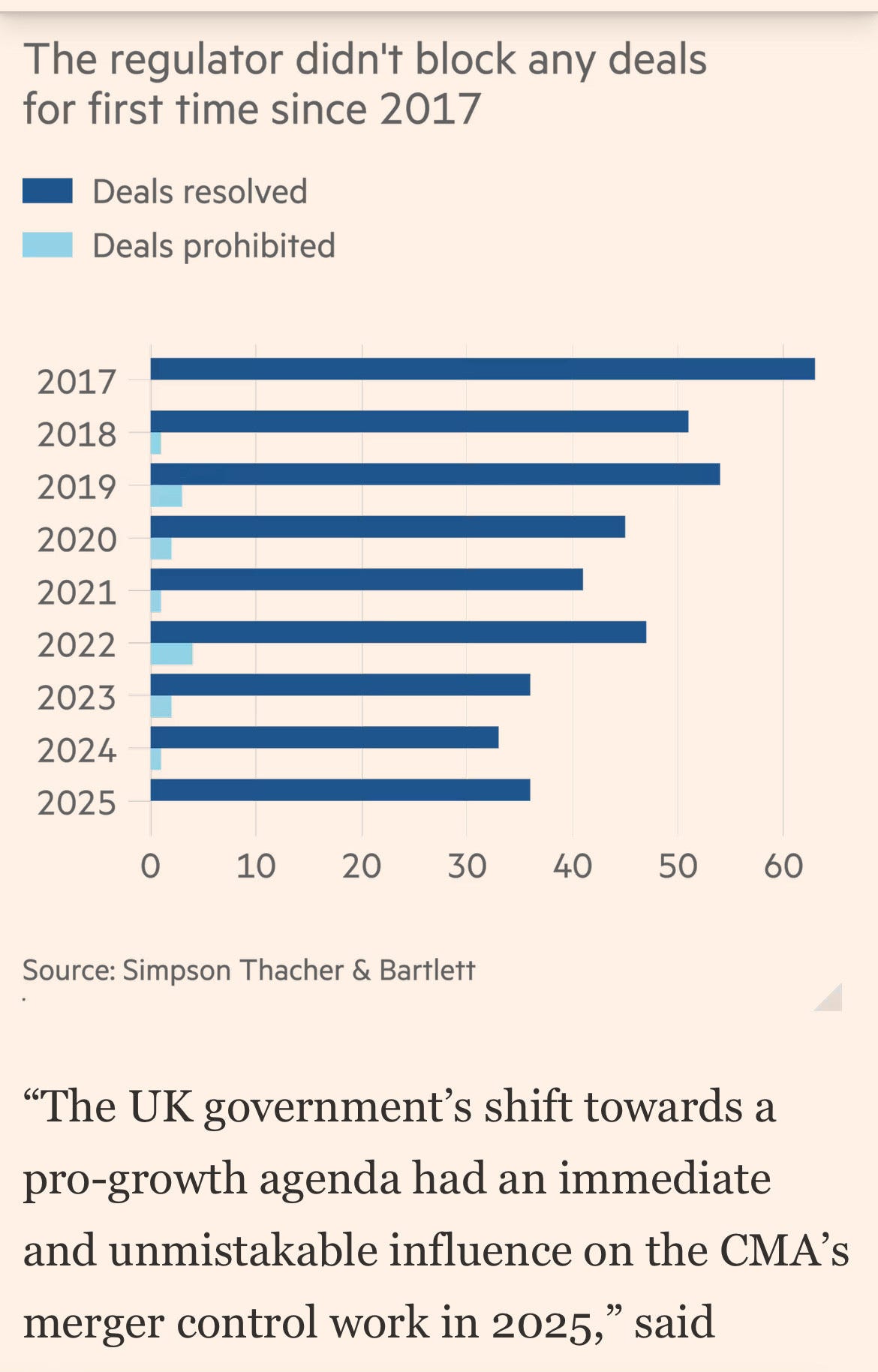
It is reasonable to assume that the raft of governance changes that the government is pushing ahead with will similarly have an impact on corporate behaviour.
The immediate challenge is not refining the existing framework we have been working with, let alone extending its reach. It is defence, for now.
Looking further ahead, we face a choice. Currently on offer is a thinner, growth-only conception of governance, in which accountability is treated as a barrier to efficiency and a cost to be minimised. Do we continue to accept that framing and try and battle within in it?
Or do we develop and articulate a new version of accountability. This might need to be less investor-centric and eschew reliance on disclosure as an easy route to reform. Such a model would also be explicitly concerned with how power and risk are allocated to different interests.
At present, the government appears to be weakening one governance model without offering another.
One frustration is that streamlining and efficiency are on the Government’s agenda for companies but not for trade unions who still need to deal with postal ballots as an example.