
easyJet takeover: ownership and control
Low turnout, EU rules and other complications

UK-listed low-cost carrier easyJet is currently subject to a takeover bid involving two US firms - Castlelake and Apollo. At the time of writing it appears that Apollo - a PE firm - will win out as the board has agreed the key financial terms of its possible offer in principle and said it would be minded to recommend a firm offer on those terms. Things should be clearer by early August.
My principal interest has been how this may be affected by shareholder votes, if at all. I am also interested in the wider question of ownership and control and as I was writing this piece some news broke, which I’ll return to at the end.
But back to voting. Regardless of whether it is Apollo or Castlelake, if the takeover proceeds via a scheme of arrangement this would typically involve both a general meeting and a court meeting. Castlelake has previously stated that it intended to implement its proposal through a scheme of arrangement, while retaining the ability to switch to a contractual offer. Apollo has not explicitly referred to a scheme of arrangement, but its references to shareholders and directors voting in favour strongly suggest that a scheme is also currently what they have in mind.
Such a scheme would normally involve shareholder votes at two meetings. The court meeting approves the scheme itself. The accompanying general meeting has votes on the special resolutions needed to implement it.
If the board does recommend an offer, most shareholders will likely support the takeover and vote in favour, but there are a few wrinkles to be aware of.
A reminder: EU ownership and control rules require airlines holding EU operating licences to be more than 50% owned and effectively controlled by qualifying European nationals. This has famously caused problems for UK-listed airlines after Brexit and, as I’ve covered previously (most recently here), has led to significantly reduced turnout at several airlines as a result. At easyJet’s AGM earlier this year turnout was under 50%. That partly reflects the suspension of voting rights attached to non-EU shares to address the ownership and control rules.
As I regularly bang on, low voting turnout creates risk. If voting turnout is low, but you do vote your voting power is powered up. This is because the relevant thresholds are based on votes cast, not the issued share capital. easyJet is starting from a low base, but could fall further. Because of the impact of merger arbitrage trades, typically utilising cash-settled derivatives, there is often greatly reduced turnout during takeovers. So we could see a low turnout at quite an important meeting.
If there is a general meeting it will typically involve special resolutions that require 75% - of votes cast, not of the issued share capital - to pass. If the general meeting turnout simply matched the AGM turnout, this means that if shareholders holding 12.5% of the ISC opposed the resolutions they would not pass. Can we think of an easyJet investor whose shareholding a) is treated as European-owned and b) is big enough to get over the 12.5% threshold? Perhaps one that also has a history of voting against management….?
It could get easier to derail the takeover if the turnout drops further below the AGM level. The amount of opposition required to block progress also falls. As we know reduced turnout can be the outcome when hedge funds trade on deals using equity derivatives rather than the underlying equity. At the moment only limited derivative positions in easyJet appear to have been disclosed - AQR and Citadel between them have 2.7%+ in such positions for example - but this might grow once the winner and the final shape of the offer become clear.
There’s another angle too: the court meeting. This has an additional hurdle. The scheme requires the support of 75% by value of the shares voted and a majority in number of the scheme shareholders voting, known as the ‘headcount test’. In theory, it could clear the first test but fail the second if enough registered scheme shareholders voted against.
There is a bit of history here. In the Dee Valley takeover by Severn Trent an opponent attempted to exploit the headcount test by gifting individual shares to hundreds of people to form a majority voted against. In that instance the chair ignored those votes and the court ultimately upheld the decision, treating it as an abuse of the process.
For what it’s worth, as things stand I’m not expecting any of these risks to actually blow any deal up, but it’s useful to be aware of them. That said, a lot does depend on what side of bed Stelios gets out of.
I’m also interested in how two US firms are going to get around the ownership and control rules. Publicly listed airlines have got around this by disenfranchising non-EU shareholders. Castlelake has proposed that a company owned and controlled by two EU-national investors would hold the controlling shareholding in the acquisition structure. Apollo has not yet publicly explained its solution.
A wholly privately owned airline backed by a US private-equity firm may face different challenges. PE firms typically put their own people on the board, select new management teams and determine strategy. That seems like quite a lot of potential ‘control’ even if they have a clever way around the ‘ownership’ question.
Just after I had written the text above I saw this news story about the EU reviewing the ownership and control rules, which lands on exactly this problem.
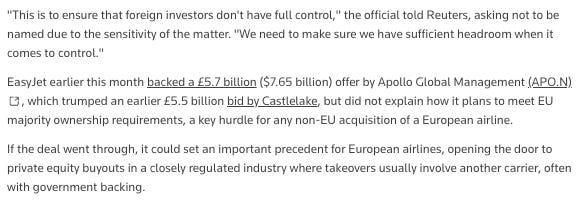
The central challenge is that investors might create a structure that superficially looks like it is compliant while retaining effective control in practice. Anyone with a working knowledge of private equity could / should ask who really appoints the board, chooses management, determines strategy and exercises decisive influence over the business. In other words: who - de facto - exercises control?
The announcement that there would be a review of the rules, to counter any belief they were not being rigorously enforced, caused this to happen:
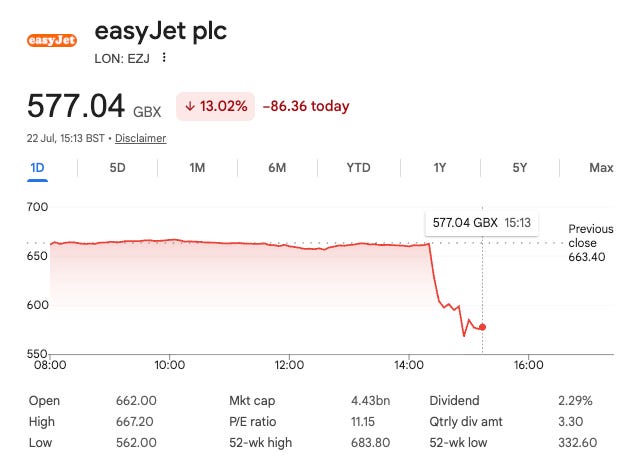
That’s regulatory risk in a bombshell.