
Derivative activism
When 'investors' aren't shareholders but might act like they are

I’ve got a bit of a nerdy interest in M&A and investor stewardship activity around it. This is an area where investor policies can be pretty weak in general, and where thinking often collapses down to ‘take the money’. In addition, the nature of investors with an interest in both targets and acquirers changes during the course of a bid.
I first got interested in the topic around the Kraft / Cadbury takeover, and then got really into the weeds on Melrose / GKN. In the latter case I was particularly interested in the tactics and impact of hedge funds doing the ‘long the target/short the acquirer’ trade using derivatives. When I dug into this I found lots of examples, not only in M&A, of funds making activist demands seemingly without ever acquiring the underlying equity.
One of the big players in that hostile takeover, which squeaked through on the narrowest of Brexit-shaped margins, was Elliott Advisors. It was very vocal in its support for the bid, where it was long GKN and short Melrose. It was repeatedly described in financial media coverage as having a ‘stake’ in GKN or sometimes even as being a shareholder. In reality it was never a shareholder and in its own statements it was clear that it had an economic interest in GKN shares, rather than holding the equity itself. I think that is why in this statement it said it was supporting the Melrose offer rather than accepting it (you can’t accept an offer for shares you don’t hold).
There are some thorny stewardship issues that flow from investors using derivatives as part of activist campaigns and/or takeovers. First is whether, or not, those investors act as if they are shareholders. What I have heard from some companies subject to bids is that they do - for example pressuring management in the target to extract as high a price as possible (for the shares the derivative holder doesn’t actually own…!)
Elliott was open about this in the hostile takeover of GKN:
In the last two months since the Offer was made public, we have been engaging with the management teams and advisors of both GKN and Melrose to understand their respective plans’ implications for the Company and the value that they would deliver for its shareholders and other stakeholders.
Second, it’s my understanding that the flipside to investors building derivative exposure to the target is investment banks (which are the counterparty to the derivatives) acquiring a large proportion the underlying equity. But they don’t typically vote it (I think there is a tax implication for the derivative holder if they try to vote, but I have not bottomed this out). That is why you often see voting turnout plummet at meetings held by takeover targets that are subject to significant investor interest through derivatives.
A good example is Meggitt’s AGM in 2022 when it was subject to a takeover by Parker-Hannifin and saw a very large derivative interest build up across numerous hedge funds. At that AGM the turnout was 25% compared to about 80% previously. One of the directors got hit with a 20%+ oppose vote and the company specifically referred to changes in the share register being a potential factor:
Whilst we believe today's vote is a reflection of overboarding concerns, we will engage with the relevant shareholders to better understand the background to their vote. It is noted that owing to the changes in our shareholder composition since the last AGM as a result of the proposed acquisition by Parker-Hannifin, only 25% of shareholders voted this year compared to just over 80% in 2021 which may have impacted the result of this vote.
I have dug into this issue in some depth and found the same pattern of high derivative interest and low voting turnout repeated at numerous takeover targets. It has also occurred at activist campaign targets too, if the activist is using derivatives to build its exposure to the target.
It’s almost 20 years old now, but I found a pretty clear explanation of the relationship between hedge funds and investment banks in an old Takeover Panel consultation. As noted, I don’t think banks do vote these days (hence the low turnout) but I think this captures some of the dynamics well (bold bit is my emphasis as I think nothing has changed in 20 years here):
First, the Code Committee believes that, notwithstanding the contractual arrangements between them, a counterparty will usually know the derivative investor’s likely wishes and therefore it would be naïve to assume that the counterparty (who has no economic interest in any hedge securities it holds but who does have an ongoing client relationship with the investor) will act without having some regard to those wishes. In addition, as indicated in paragraph 3.3 of PCP 2005/1, the Code Committee understands that it is frequently the expectation of a long derivative investor, notwithstanding the terms of the documentation, that his counterparty will ensure that the securities to which the derivative is referenced are available to be voted by the counterparty and/or sold to the investor on closing out the contract. If the counterparty does not hold any such securities (because, for example, its book is balanced by an offsetting short derivative), the investor would normally expect the counterparty to acquire the necessary securities, even if that resulted in a cost to the counterparty.…..the Panel continues to encounter situations where holders of long derivative positions behave as if they were shareholders and, more importantly, situations where investment bank counterparties enquire of investors with long derivative positions as to their preferences in terms of bid outcomes in order that the counterparties may take those preferences into account;
Why do I trawl back through all this? Because there is a live, large takeover battle brewing - Anglo American and BHP - and a familiar face is in the mix.
Elliott Advisors has again been described as having a ‘stake’ in Anglo, and disclosures last week show that it is long Anglo (and short BHP, the latter is a very small position though). The filings also show that its exposure to Anglo is through cash-settled derivatives - not the underlying shares - and it appears these are equity swaps.
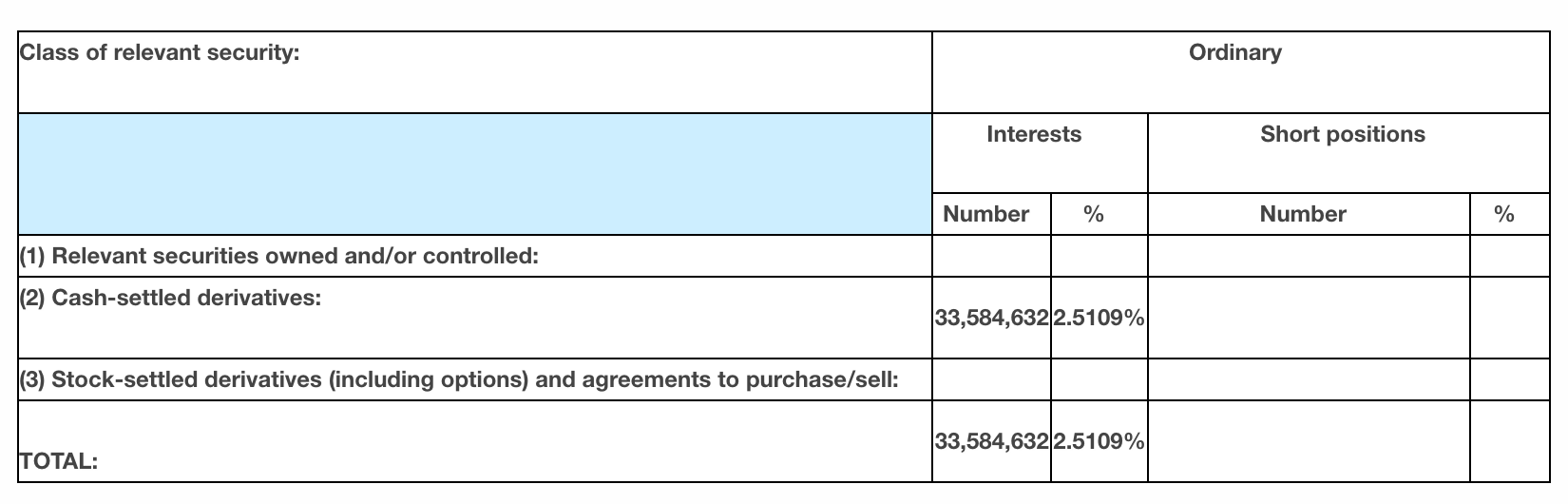
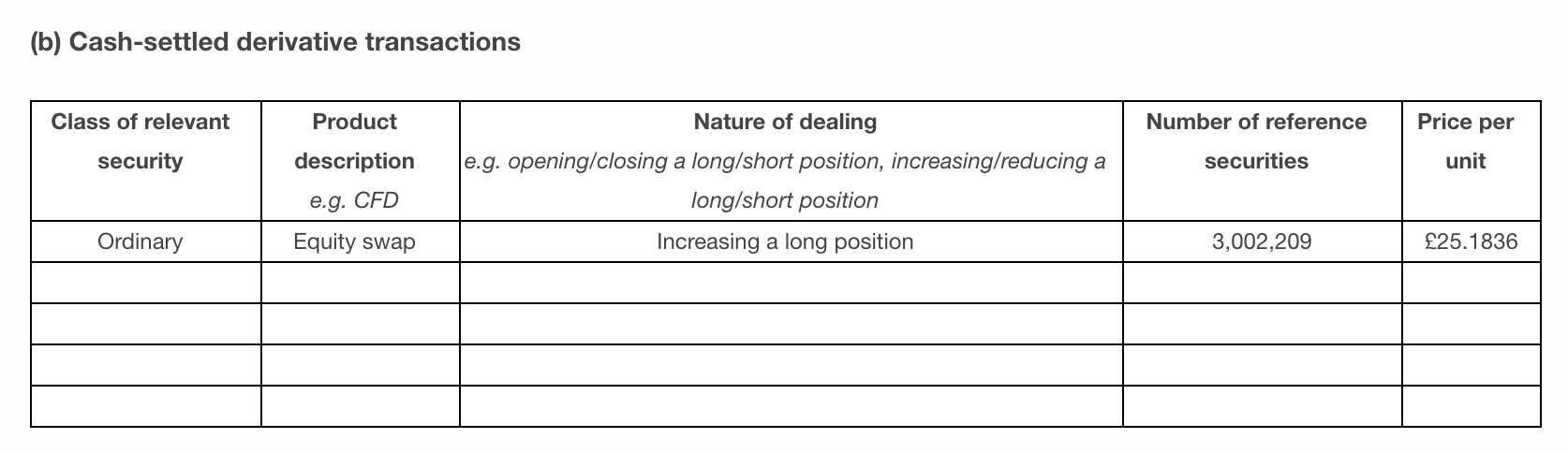
To spell out the ‘cash settled’ bit, in practice this should mean that Elliott either receives or has to pay cash, depending on the movement in share price, without the underlying shares themselves ever being acquired. In other words there is no expectation, based on these disclosures, that Elliott will become a shareholder.
As an aside, Anglo had its AGM this week and voting turnout was about 65% having been routinely in the 69-70% range for the previous 4 years. I think it’s too early for derivatives to have made an impact because the bid news is very recent, but it’s possible. If more hedge funds start piling into Anglo and using derivatives I have no doubt we will see an impact if the company holds a meeting.
A slightly wonky analogy I have for these practices is that derivative holders are like people betting on a football game, rather than having paid for a season ticket. I personally find it grating to hear them weigh in on what should happen to the target company having only just shown up and not having any real commitment. I also find it frustrating when financial media fail to spell out precisely what their relationship is to the company.
This is not what ‘stewardship’ ought to look like in my opinion, and the idea that hedge funds take that concept seriously is laughable, as their own boilerplate disclosures show. Unfortunately, long-only investors don’t typically ride to the rescue either, usually being quite happy to take the premium, again rather undercutting lofty talk about being committed to the long term. It is striking how little is said about M&A in most investors’ stewardship policies despite this being pretty fundamental to the companies and their workforces.
And similarly, if the City was as concerned about the number of companies listed in London as it is about the number of companies listing then we’d pay more attention to these issues. But it seems London’s real interest is largely in activity, not longevity.
So I’ll be watching the Anglo/BHP battle with interest. To fellow M&A nerds working in stewardship keep an eye on the derivative exposure and any voting turnout impact. I’ll aim to do an update post if I see more funds coming in using derivatives. And similarly if Elliott becomes publicly vocal about the bid let’s see how their interest in Anglo is described in the media. At the time of writing its disclosures show it is not a shareholder.