
Allocation, Ownership and Control
Quick snips

Thanks to everyone who joined my recent webinar on Populism and Responsible Investment. I’m really pleased that it has generated interest and debate. As I said at the outset, I’m not claiming that this account is definitive, but I do think that some of the movements and ideas visible in national politics are spilling over into responsible investment and stewardship.
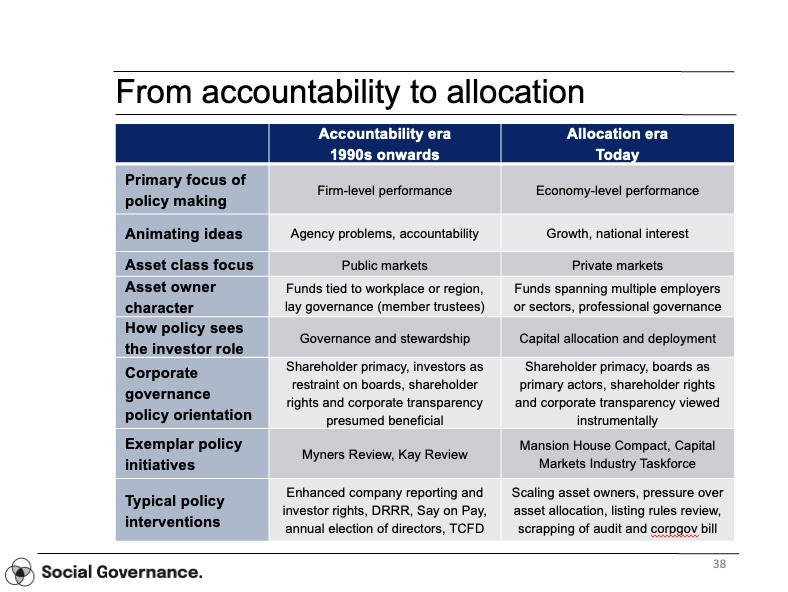
So in this quick post I want to highlight two points. Firstly, I think there is an ongoing shift in policy thinking about investors away from “accountability” and towards “allocation”. I am simplifying the distinction to make the direction of travel clearer. As with all such shifts, it is uneven and subject to counter-movements. I tried to capture this movement in the slide below. I am very interested in views about whether this is fair, what it misses and so on.
Secondly, I also briefly touched on ownership and control.1 I’ve been thinking about this in more detail, so here are two slides (I only used one in the populism deck). My key point really is there is a difference between public ownership and public control and there is a spectrum on which different approaches sit (again simplified - there’s a significant difference between an operating franchise and ownership of company / asset for example).
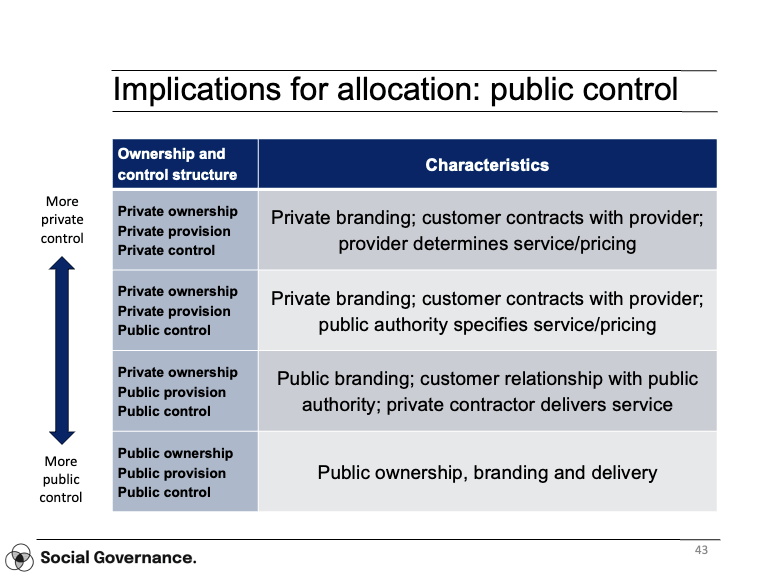
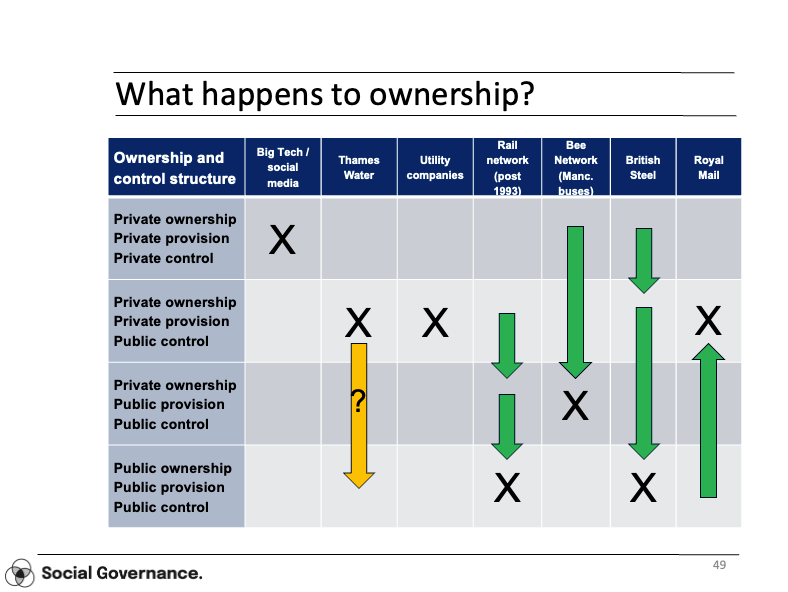
The verbal distinction between public ownership and public control is slight, but the policy distinction is enormous. It is significant that the UK’s new Prime Minister, Andy Burnham, talks about public control. That more closely describes the model he developed through the Bee Network in Manchester.
It is also interesting to note that the previous Conservative government’s proposals for Great British Rail were structurally similar (public brand / interface, extensive political control but continued reliance on private-sector operators).
My own view is that the increasing public control of an originally privatised service paved the way for re-nationalisation of rail, regardless of one’s view of the merits of public ownership or its likely effect on services. One can imagine something similar with buses. The more that public authorities intervene and determine costs and revenues (eg fare caps, subsidies for shifting to EVs etc) as well as service levels the more it provokes the question “why are we paying the private sector to deliver this?”
There seem to be implications for infrastructure investment here (and note that a couple of bus operating companies have been bought by infrastructure funds). Assets may remain privately owned while national / regional / local public authorities increasingly determine prices, subsidies, procurement (eg of vehicles) and service expectations. At some point, private ownership may begin to look less like a mechanism for introducing competitive efficiency to service provision and more like a contestable financial claim on a public system.
If there is a common thread in these two trends it is the assertion of public interest. This inevitably provokes further questions - which public(s), and what do we understand that they want? That may be where the action is in future.
PS. Please get in touch if you would like a copy of the webinar slides.
I also referred to this recent IMF paper on nationalisation - https://www.imf.org/en/publications/fandd/issues/2026/06/the-new-wave-of-nationalization-nicholas-mulder