

I wrote recently about the shift in the way that policymakers seem to perceive the role of investors and what it might lead to. As a reminder here is my simplistic framework.
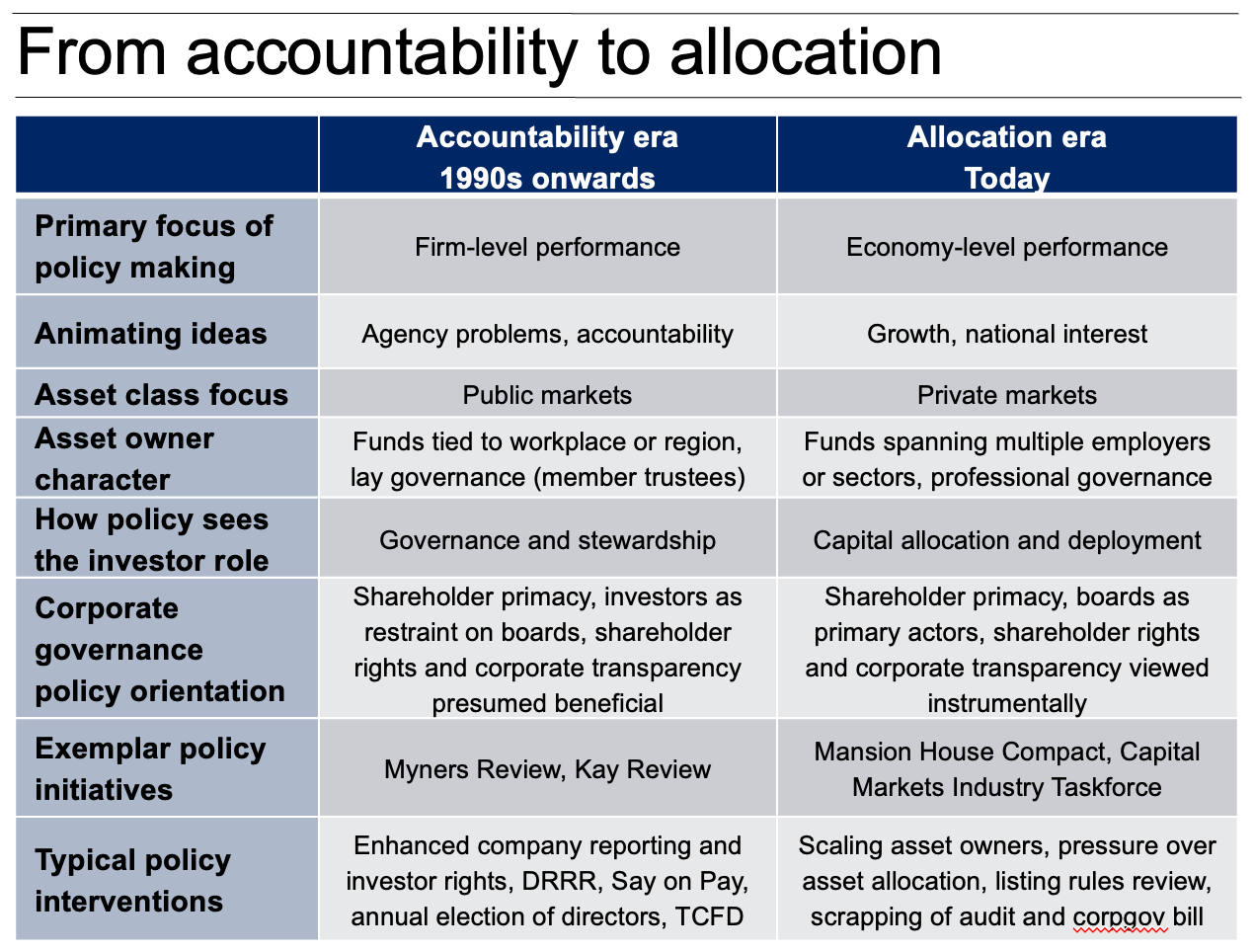
I had not expected clear-cut evidence of this quite so quickly.
The government’s consultation on corporate reporting, launched today, and the language used in and around it, underline the argument I was making.
Just a few immediate headlines for governance wonks, the Government is considering:
Removing the requirement for an annual vote on remuneration reports
Removing reporting requirements such as on the work of the remuneration committee and the CEO-employee pay ratio
‘Clarifying’ the law to make it clear that annual general meetings can take place virtually where there is shareholder consent
Revoking the Reports on Payments to Governments Regulations 2014
In the area of remuneration reporting alone, the proposal is to substantially reduce the range of information provided. In addition to getting rid of the pay ratio reporting requirement, it is proposed to remove the requirement to report on:
The relative importance of spend on pay
Executive directors’ pay prior to the company becoming a listed company
The illustration of long-term incentive plan outcome in the event of 50% share price appreciation during the performance period results, which results in an artificial maximum executive pay figure that is not useful for investors
Information on the work of the remuneration committee, including disclosure of any parties providing advice to it
Malus and clawback policies, and any use of malus and clawback in the previous year
How the remuneration committee has engaged with shareholders on pay proposals
How the remuneration committee has engaged with employees on pay proposals
How directors’ remuneration aligns with wider employee pay policies
How a company is addressing any significant shareholder dissent on a vote on directors’ remuneration
The broader consultation goes further, the Government also seeks to
Clarify who the annual report and accounts are for by reaffirming that they are a document primarily intended for investors and creditors
Test the merits of non-financial reporting requirements for private companies
Simplify and streamline the strategic report requirements
There is a very clear articulation of the purpose of all this:
The annual report and accounts should be a focused document designed for a specific audience. The government proposes that the purpose should be to provide financially material and decision-useful information to investors and creditors
This is very much focused on information that enables providers of financial capital to make allocation decisions. The word “stewardship” does not appear in the document. Ultimately the tests here are a) will investors or creditors use the reporting and b) is the burden of reporting reasonable? If the Government isn’t convinced that the answer to both is ‘Yes’ then there will be pressure to remove reporting requirements. Accountability mechanisms are being judged by an allocation-era test.
Note too that investors are still seen as the primary users of accounts, and therefore the information provided is intended to be useful to them. This is in line with a model of policy, where shareholder primacy remains as an operating principle, but does not necessarily entail shareholder rights. Indeed they can in some cases be seen as in conflict with the objective.
All of this is very much the direction of travel I was trying to capture in my Accountability vs Allocation framework, but it goes much further than I was expecting.
It is really striking that much of the ‘accountability’ architecture that is proposed for removal was either introduced by or supported by the Labour Party. I’ve written before that there are legitimate grounds for reviewing the range of reporting and governance requirements placed on business. Costly, low-value requirements benefit nobody. But let’s be absolutely clear which existing requirements do actually fit that description. More importantly, for a Left-of-centre party I believe this kind of exercise needs to be part of a wider conception of business and finance in society.
There is an argument that much of the architecture that was put in place from the 1990s onwards has done its job. Boards are far more independent and professional, shareholders are more engaged. Perhaps we don’t need formalised rules or reporting any longer? But we should be aware that there might be a kind of ‘half life’ to good governance that is not underpinned by regulation. Behaviour might start drifting back to where it started.
In my habit of using Right-of-centre figures to inform Left-of-centre policy, consider Chesterton’s fence:
In the matter of reforming things, as distinct from deforming them, there is one plain and simple principle; a principle which will probably be called a paradox. There exists in such a case a certain institution or law; let us say, for the sake of simplicity, a fence or gate erected across a road. The more modern type of reformer goes gaily up to it and says, “I don’t see the use of this; let us clear it away.” To which the more intelligent type of reformer will do well to answer: “If you don’t see the use of it, I certainly won’t let you clear it away. Go away and think. Then, when you can come back and tell me that you do see the use of it, I may allow you to destroy it.
Given its experience with ‘light touch’ regulation of the finance sector in the lead up to the financial crisis, this is the type of problem one would think a Labour government ought to think through very carefully.
It is possible that this Government looks more at ownership and control in a broader sense, as Andy Burnham seemed to suggest in Parliament last week.
People yearn to see them restored to what they once were, as the Community Secretary and I heard on our visit to Ilkeston in the summer.
But they see no hope if we continue on the same path, with a failed economic model which does not trickle down much to places like theirs and instead allows wealth to be extracted and siphoned out.
Britain’s water industry stands as a leaking monument to that approach. A country run in the private rather than public interest.
The government I lead will be relentless in giving people and places what they were promised 10 years ago, ownership and control. And from that control over their destiny comes change and growth.
We can see with developments at British Steel the government will entertain a different kind of model. More generally, there seems to remain a sizeable gap in Labour’s thinking. Improving economic growth remains an over-riding objective, but is that it? It feels out of step with Burnham’s rhetoric to date.
This consultation was in the works before Burnham replaced Keir Starmer as Prime Minister, and it is still a consultation. There is time to respond and potentially dissuade the government from taking some of the actions proposed. But the ideas behind it seem to encapsulate the shift in policy orientation identified at the start. The language of accountability - to investors - is very clearly giving way to the language of investor decision-usefulness and capital allocation